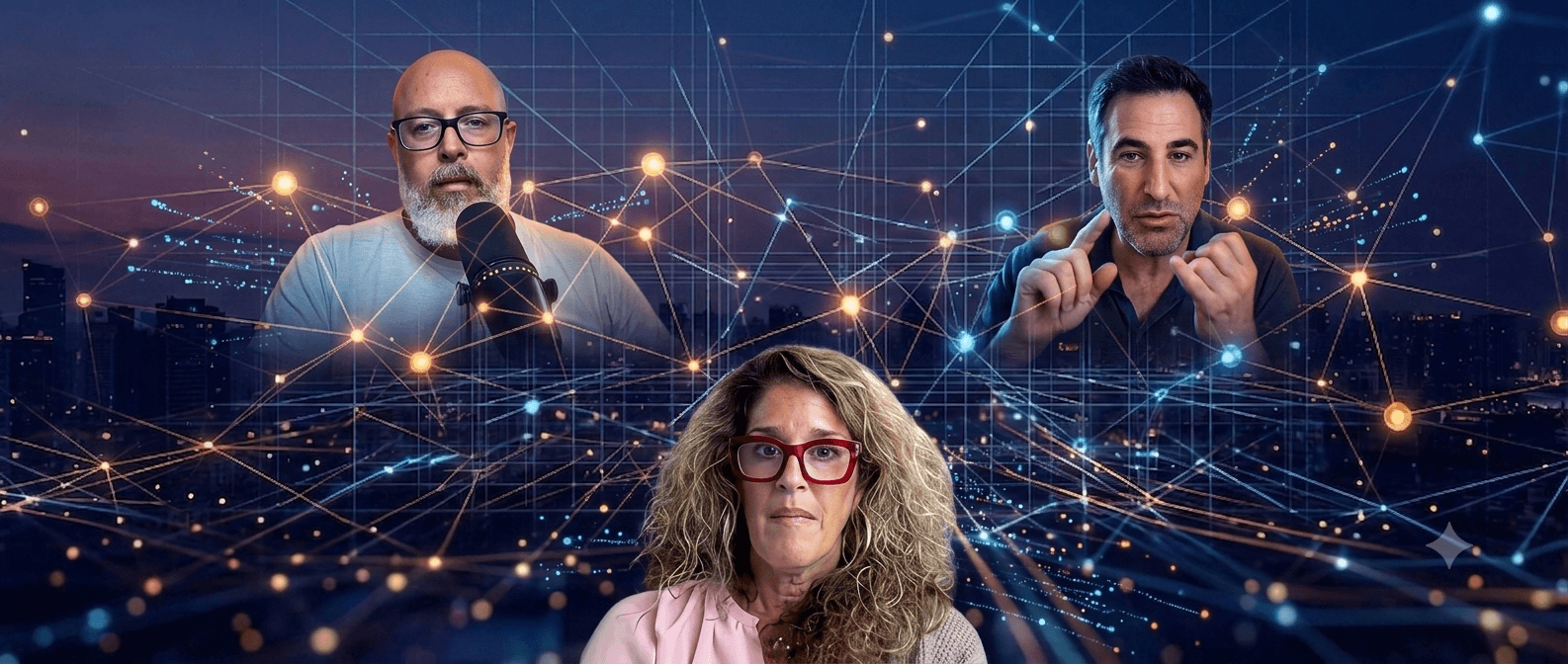
**Lio** [00:20]
Hello everyone, I'm Lio. This is Seth. We are here. Lio? Yeah — well, wherever you are, this is The Jew Function, and we're very happy to be here, not for the first time, and probably not for the last time either.
We're the only podcast out there that's committed to solving antisemitism — to really solve it. We want to take it apart and shift reality into a different place altogether. So we looked at everything: history, historic patterns, the words of Jewish sages throughout the generations, network science — everything. And all the findings lead to one place: when Jews unite, the world is a better place. When Jews go at each other's necks, it's a problem, and the world doesn't like it.
Now, the world doesn't necessarily know it. Jews also don't know it. But if you're a Jew listening to The Jew Function, you know it. It's a process we've been seeing throughout history, that we've been hearing about from Jewish sages, and that we've seen examples of in network science. And when it's not happening — when Jews go against that directive to unite, to bring people together above their differences — the reaction of the world is usually violent, and it's not good.
So if you only remember one thing from this show, remember this. We're on all the platforms — obviously Spotify and YouTube, but also Facebook, Instagram, X, even TikTok. So you can find us. Like us, please; comment; share, because people need to see this conversation; and subscribe. And this is all voluntary, so Seth and I aren't making any money from it. For some reason, we're terrible Jews at that.
Beyond that, we have a great guest with us today. She's been portrayed as a viral Jewish history explainer, but mostly she's a fierce commentator — one of those people who are really passionate about antisemitism and Jew hatred. She posts essays on the topic, and the posts she shares on her channels have become a go-to place for people trying to understand what's actually happening with Jews right now. She talks about all the lazy conspiracies, the shape-shifting narrative of antisemitism, and the irrational hatred we've been talking about here on The Jew Function. And she'll help us get a little closer, I hope, to the truth — and to how to not only unite against antisemitism, but really unite for the future of all Jews. Please welcome Melissa Brodsky.
**Melissa** [03:32]
Hi, guys. Thank you for having me. Very happy to be here.
**Lio** [03:37]
We're happy to have you here. So, Melissa, let's cut to the chase. How do we get Jews to band together and stop this antisemitism, this Jew hatred, from happening?
**Melissa** [03:56]
We've got to start by agreeing that we need to have a commonality. We are Jews. It doesn't matter if you're on the left or the right or wherever — at the end of the day, we're a family, and we need to come together and—
**Lio** [04:17]
—prove everybody wrong. I like to do that. And it is an important first step to point out that there is such a thing as Jew hatred, and that it's aimed at Jews. It's not some generic hatred; it's anti-Jewish. We don't even like calling it "antisemitism" anymore, because it's really not Semitism-directed hatred. It's against Jewish people. It's not against some ideology, some "ism." It's against Jews.
So, we agree. A lot of people come here, and they're really passionate advocates — some of them reluctantly, after October 7th. And they all share the same thing: we've got to let the world know there's this double standard, it's not fair, and people need to know the facts. That's an important first step, an important first reaction. But then comes the realization that maybe that's not moving the dial enough. And numerically, we're a small percentage. We're a drop in the ocean. If the haters really want to, they can drown a lot of the Jewish voices with ease, even with all of our influence. So what are we doing wrong? How do you deal with it?
**Melissa** [05:48]
I try to "fight with facts," air quotes. They don't seem to necessarily work. But to me, it's not about talking to the actual haters. It's about talking to the people who are watching in the background. Those are the people we want to bring to reality. We want to let them know that what they're seeing is such an inverted truth — and that if they just did a little digging into any of these subjects, they'd realize it's inverted, and that we're telling the truth. So those are the people I want to talk to. That's my audience.
Plus, I try to give people the tools to do that too. I have a lot of resources on my Substack for paid subscribers — I call them "truth bombs." They're just these little memes. And I tell my followers: you can take them, put them in AI, have it rewritten in your voice, and then use them all over the internet. Use them to respond to the trolls. Right now that's the only thing I can think of to fight back — that, or block them. Because the reality is, the people who've already made up their minds are not going to change them. There's going to have to be some sort of deconditioning, de-brainwashing. I don't know if you ever saw *A Clockwork Orange*, where the guy sits there — we're going to have to do something like that.
**Lio** [07:43]
I think it's a great idea to sit all the antisemites down with little toothpicks in their eyes and have them watch Claude Lanzmann's nine-hour Holocaust movie, right?
**Melissa** [07:55]
That's one idea.
**Lio** [08:00]
I'm sure some people are working on it in the background already. But here's what Seth and I found from our extensive research — and we've been researching this before it was fashionable to look for solutions to antisemitism and Jew hatred, back when people were saying, "No, don't say 'Jew hatred,' don't give anyone ideas, it's all fine." And we said, "No, it's not fine. It's starting to be very not fine." People insisted that society wasn't going to let it happen. And lo and behold, society is not only letting it happen, it's participating, encouraging, taking bets on it.
So we were looking for what's actually happening — because everything in nature, every phenomenon, has a root, a beginning, and an end. Everything leads to something; nothing happens for no reason. Even if you don't see the beginning and the end, every process in nature has them. You plant an orange, you get an orange. Even if you meet it in the middle, when it looks like a tiny green sour thing, in the end it's going to be an orange. If you know what you planted, you know what you're going to get.
So, long-winded way of saying: we did the research, and we found that the thing that plays a big role in why people hate us — what they need from us — is the way Jews relate to one another. The way we relate to each other has everything to do with the reaction of the world to us.
**Melissa** [09:50]
Yeah.
**Lio** [09:50]
How does that sit with you — this concept, this premise?
**Melissa** [09:54]
I agree. For example, when I write something about antisemitism on my Facebook page, I get the "as-a-Jews" coming at me, saying, "You make everything antisemitic." And I'm like, that's because it is. They're telling us that they hate us. And the "as-a-Jews" are the ones the haters use as the idol — the example of why it's okay to hate us. That's why we need to get aligned.
There's one in particular I'm thinking of. Sometimes, if we agree on something, I'll say to him, "Look — we agree. We actually agree on something. A miracle." We need more of that, because the more united we are, the less ammunition we give them, like you said. And I don't know how that's going to happen, because we don't agree on anything — we never have, historically, in our entire 3,000-year history. So I think the one thing we all need to agree on is that there is rampant Jew hatred, and we need to come together to fight it. It's a bipartisan thing. It's both sides. It doesn't matter how you were brought up as a Jew, whether you're Orthodox or whatever, or whether you're a Democrat or a Republican. Jew hatred is the thing we need to really tackle. And we need the silent-majority Jews to be more vocal, too. We need to figure out how to activate them.
**Seth** [11:44]
Melissa, when you go across this population of people, it's kind of like a sieve. You scoop up the whole group, and then a few people remain while most of the stuff goes through the screen. Who are the ones that are open to it? First of all, there are going to be people who are born advocates — they're already on the team. But who are the ones, and what are the conditions under which somebody gets it? Doing this is really going to take a few generations of education. If you're raised from the time you're five years old that your job in life is to kill these people, we're not going to change that tomorrow; that's going to be a cultural thing. But who are the people who are the low-hanging fruit?
**Melissa** [12:38]
I think it's the people who— First of all, there are the lurkers, and I think that's part of the low-hanging fruit.
**Seth** [12:43]
Give us — actually, also — real-life situations that you've seen through your experience.
**Melissa** [12:56]
I have a ton. It's a lot of the older generation — even the generation beyond me, the boomers — that I feel need the tools. They don't necessarily understand the technology to really get out there and fight, or they're scared. But they're the ones sharing my posts; they're the ones messaging me and calling me. Those are the ones we really need to figure out how to teach. Because they have a longer lived experience, I think they could have a really powerful voice — they just don't know how to use it. That's what I'm seeing, at least. Those are the people I message with all day long. They're in their mid-to-late 60s into their early 80s, and I think they're so brilliant and they see things so clearly. We need to teach them how to do this.
**Seth** [13:53]
Do you see them as Democrats and Republicans both, together?
**Melissa** [13:59]
Yeah, oh yeah.
**Seth** [14:01]
Yeah.
**Melissa** [14:01]
I'd say mostly left-leaning. But yeah, I have a bunch of Jexit people — people who were on the left and have moved with me toward the moderate, almost to the right.
**Lio** [14:15]
They just switch camps, right?
**Melissa** [14:18]
Yeah.
**Lio** [14:18]
Like who — Alan Dershowitz? Six or seven years ago he was with the Democrats, and now—
**Melissa** [14:25]
—and then you have the Democrats saying he was always a Republican, he was always a closet Republican.
**Lio** [14:33]
It's funny, because — I don't know if you saw it — there was a big "closet Bibi supporter" video that came out of Israel.
**Melissa**
Oh, jeez.
**Lio**
It was huge, just last week. Just a couple of guys. One is young, very charismatic, very skilled — an internet reporter, he calls himself, but he was working in high tech, doing acting and sound work. This guy is very, very good. And then there's an older musician guy who was on the left and switched to the right. They'd both been commenting on the side, and then they got together — and they got the guy's mom in on it too. They did this video where they're sitting around the dinner table, and it's like, "Mom, Dad, I've got something to say." And the mom goes, "Oh my God, you're gay!" And he's like, "No, I'm not gay." "Just let the kid say he's gay!" "I'm not gay — I actually support Bibi." And they're like, "How can it be? You work in high tech, you like culture, you read books." They hit all the buttons — all the bias and all the misconceptions about that position. And then it went viral. Bibi posted it, and then Elon Musk posted it—
**Melissa**
And he got like—
**Lio**
—50 million views in a matter of a week. I'm sure you'll find a version with English translation as well.
But it kind of comes down to — I didn't know if we should bring any politics into it — in a way, the question we're trying to solve has to do with, as you said, getting people to first ask the questions and get mobilized around it. It's not one of those problems you can just throw money at and it'll go away. I think people are realizing you have to get involved somehow. They may not know what to do, but they feel like, "I have to get interested. It has to interest me. I have to get educated, informed, involved — something." That's one thing.
Then we also notice that it's tied to the deeper questions about the meaning of life. Suddenly it's: what is a Jew? Who is a Jew? What does it mean to be a Jew — this 3,000-year-old history of this people that culminated in the Land of Israel, and everything that's happening there? Suddenly it stops being just random events; it starts to feel like there's a bigger play here. And it has to do with this history, maybe with the meaning of life, maybe with the meaning of everything. So people are open to that — even people who are totally non-religious.
And then it also has to do with your political views — but not in the sense of "I vote this, I vote that." When I say "political," I mean your view on life's big issues. Not just the meaning of life up here, but also how you relate to other people: to people who are trying to kill you, to people who are trying to be friends with you. Who are you putting in power? Where should the money go? Big questions.
And I'm curious to hear if you feel the same, but it feels like a lot of the stuff we believed in — and I'm bundling us in it, even though we're maybe a little younger than the people you're talking about — a lot of the stuff we grew up believing is no longer necessarily right. Do you feel that?
**Melissa** [18:16]
Yeah, I feel like — what I grew up believing... yeah. It's hard for me to put a finger on it. I'm actually writing about something like that right now, and I'm having a really hard time, because I can't put my finger on it. There is something changing, something beyond what I've ever learned.
This is why — when I started really getting into writing about antisemitism and Judaism full-time, I had to figure out what direction I wanted to go. My first posts after October 7th were angry; I was just angry. And I'd get told to shut up, and I'd get blocked, all that. Then more recently — I started really doing this in December — I realized the only way I can learn about what's going on is by knowing the history of our people. Because I know nothing. I literally know nothing. I learned what I was taught in Hebrew school, in Sunday school, and I barely remember that, because it was a million and a half years ago. I'm a little older than my following. So my whole thing right now is starting from the beginning. I'm working my way through each expulsion, from each—
**Lio** [19:36]
I just thought it'd be a good time to interject that the first season of The Jew Function — the first 22 episodes — does exactly that. If you listen to it one by one, it'll give you a brief history lesson and dispel a lot of the myths we grew up with.
**Seth** [19:53]
You can also take any period in history. You could take Hanukkah, you could take Purim, and just listen to that episode. It's like — you were told your whole life that kids come from a stork. You know that story? And then you hear this. They don't come from a stork? It's unbelievable.
I said this back in those episodes: I thought the Jews were kind of like a Woody Allen character — we're just living our lives, and then people wanted to kill us for some reason. Jews have always been very powerful, very influential, big influencers in the world, and it always evoked something out of humanity. I have this quote here from Winston Churchill — one of the most influential people of the 20th century: "Some people like the Jews, some people don't, but no thoughtful man can deny the fact that they are, beyond any question, the most formidable and most remarkable race which has appeared in the world."
And it's hard for us — I think even when you tell people these kinds of things over and over again, it doesn't enter the ear. If you took a cat to the opera, you could be crying from something so beautiful, but it's going to go right over the cat's head. He's not going to get it. And I think most people are like that. That's why I asked you the question earlier — when you put your sieve out, who's left? Because what we understand from what's going on is that this is leading us to ask a bigger question. Not just "Why do people hate the Jews?" or "Stop hating the Jews," or "Don't you see the UN isn't fair?" or "Don't you see we're the most ethical army in the world?" or "Don't you see Assad killed more people, or Ahmadinejad, or whoever?" It's forcing us to ask a bigger question: who the hell are these Jews, and what the hell are they doing on this planet with the rest of us? And is there some greater purpose — for all of humanity? Not that the Jews are some unique thing off by themselves, but: what is the purpose of this for everyone?
I think until we ask the big questions and dive into who we are and what our role is, we won't be able to. You know *The Hitchhiker's Guide to the Galaxy*? I read that ages ago. It's amazing that today it's not about the answer anymore — all the answers, all the information, is available. It's: who's got the question?
**Melissa** [23:02]
Right. We're not asking the right question.
**Lio** [23:04]
Yeah. A lot of guests have come here and said that exact line. So the question is: what questions should we be asking?
**Melissa** [23:13]
If I knew, I think I'd be able to solve antisemitism, instead of working backwards through it.
**Lio** [23:19]
Well, let's start with this: if you could ask anyone anything about it, what would you ask, right now, at this point in time? You're clearly involved. You're invested. You have skin in the game. What would you want to know? Imagine Seth and I hold all the answers — let's play this game.
**Melissa** [23:45]
Honestly, my biggest question is: why the Jews? We are the smallest. It's all the clichés — all the facts that we throw at people — but they're the truth, and yet it lands like white noise. How can we reframe "why the Jews" so it doesn't sound like white noise — so the answers don't sound like white noise anymore? That's what I'm trying to work through.
**Lio** [24:14]
This is great. By the way, Churchill also said that antisemitism is when you hate the Jews more than is necessary.
**Melissa** [24:21]
Yeah.
**Lio** [24:24]
But "why the Jews?" Well — would it help if the answer were, "Someone has to do it, and it just happens to be this group"?
**Seth** [24:38]
Yeah. Someone has to do what?
**Lio** [24:41]
Okay, that's a different question. I was just trying to give—
**Seth** [24:45]
Let's also — and I think this is a question people bury — what the hell are we alive for? What is the meaning of our life? Because if everyone's asking that question, then the Jew has a claim to something. But if we're all just living our animal lives, chasing from one thing to the other, then there's no need for the Jew; we're all just well-dressed, fashionable animals. But if we're asking what the purpose of our life is — I think that's the question that leads to—
**Melissa** [25:28]
—then, who is the Jew? Because it's beyond "be fruitful and multiply." There's—
**Lio** [25:36]
You don't need — let's say you don't need to make that a directive, because that's what nature does anyway. If you're an animal and you forgot about it, then let me remind you. But anything beyond the monkey — and we keep bringing the monkeys into the show, because it's true — you go beyond the monkey and you realize something gets off. All the animals exist more or less in harmony with nature and with each other. They only kill to eat, and not beyond that — it's part of a system; there's no excess of anything. But somehow, when you made that leap into humanity, this balance broke. We kill more than we need. We take advantage of other people. We exploit everyone to our own benefit. We basically want to get pleasure out of everything and everyone — and not get caught in the process. That's kind of the human formula.
So the question is: why would nature create such a destructive race, unless there was a deeper reason for it? I'm putting the question out there — you can say, "No, I don't know."
**Melissa** [26:55]
That's not a rabbit hole I've ever thought to go down. To me — I was thinking about how I responded to an article recently, about how hatred in general is pleasurable. And it is. When you target a group — the Jews, or the Blacks, or whomever — it creates this unity around one target. You're a group of people going after a target, and it's fun, it's gleeful. Like book burnings — they have fun doing it. And lynchings. Don't forget witch burnings.
**Lio**
It's also great — witch burning.
**Melissa**
I wrote about that — the Salem witch trials. I mean, it was... and that's the kind of rabbit hole I've gone down. But the one you just brought up, I never thought about. I'm going to need to start ruminating on it.
**Lio** [28:06]
Okay, this is good. Look, the great thing about being Jewish is that you're part of a long line of people who have been thinking about these things, and really trying with all their might to attain it. Now, that's not to say other cultures don't have their own versions of seekers, who use different methods to try to connect with a higher — let's call it — level of existence, just to use the vernacular. But with the Jews, what's interesting is, A, it's an unbroken chain. It has a lot of other streams branching off of it, but for the most part it's one unbroken chain. It's using more or less the same source books throughout. It's all documented — and not only documented, it's all hyperlinked, like the Talmud: he said it based on what he said, based on what he said, based on what they said. It's an amazing system.
When I grew up — totally secular household — it didn't even occur to me that there's this huge wisdom. It felt like something that happened in the past. And now we're like, "It's the 21st century, let's just focus on—" What are you talking about? How do you think the world looks the way it does — especially Western civilization — if not because of this Jewish wisdom? People have given a lot of thought to all of this over the years, so we can look into that. That's what we did. We looked into the Jewish sages — that was one of the first places we looked for direction. And guess what? You find a lot of great direction. Seth, do you have a quote from the sages, with some direction?
**Seth** [29:57]
Give me a minute to grab one.
**Lio** [29:58]
Yeah, okay, I'll give you a minute.
So — this is a great thing. I went after — I grew up kind of the way you describe it. I went after the witches and the psychedelics and the shamans and the Bhagavad Gita — you name it. Wherever it smelled a little esoteric, I'd be there.
**Melissa** [30:24]
Yeah, that's interesting.
**Lio** [30:26]
And interestingly enough, in a lot of those places you also find Jews. Even there, you find some of the great people who brought, quote-unquote, "spirituality" to the West — almost always Jews, from Ram Dass to Jesus. So it's interesting; it's like we're sitting on something.
From Ram Dass to Jesus — yeah, I wanted to bookend on that. So it's interesting. And I'm going to ask you again — to think about it — maybe now, with everything we've talked about. It's the question we usually ask people who come here: how would you define a Jew to an alien? We brought *The Hitchhiker's Guide to the Galaxy* — imagine you open it and there's an entry, "Jew." What would it say?
**Melissa** [31:22]
I actually had to write that down, because I thought it was such an interesting question when I got the list of questions.
**Lio** [31:29]
Oh — they said you could? Okay.
**Melissa** [31:31]
So the only thing I could come up with is that Jews are a people. We're a tribe. We're a nation, tied together — I feel like — in our DNA. And I didn't realize how deeply tied into our DNA until after October 7th, when I feel like that was activated. That's when a lot of us really became Jewish and Zionist.
So what I'd say to an alien — well, you'd have to start by describing what religion is, and that would take forever, and ethnicity too. So I'd just have to say: we are a people with a 3,000-year history, maybe even longer. We don't have a single set of beliefs, and we don't have a single bloodline, yet we're a family, and we've been scattered across almost every civilization on Earth throughout history — and somehow we're still here, because we're resilient. There are just so many different things to describe a Jew. We're not a religion; we are a people, we are a nation, we are a tribe. And hopefully they'll be able to figure it out from there — because I honestly think Jews are one of the most complex things to describe, because there are so many different versions of us operating under the same umbrella.
**Lio** [33:04]
Granted. And the people who persecute Jews usually have to label us as something, so they do. And then over time, you see how even those labels contradict each other and clash: capitalists and communists, revolutionaries and isolationists; they assimilate, and they keep to themselves; loyalty — yeah, it's from the father's side, it's from the mother's side; it's this, it's that, it's always. We need a deeper definition. Seth, do you have something?
**Seth** [33:38]
Yeah, I've got this. There's so much. This book by Michael Laitman, *The New Antisemitism* — he's got a whole section at the back of quotes from the Jewish sages, all about the unity of the Jewish people.
I was going to say: when we climbed down out of the trees a couple hundred thousand years ago and became humans, it was savage. People living, eating — you know, a monkey will tear the limb off another monkey and eat it. Some are vegetarians, but they also eat each other. To be a brotherhood of man, to be like world peace — this is what the Jews brought to Earth. That even though we're all different — like in the jungle — we can all be together in peace. I think that's the main message from all these quotes I'm reading here.
This is from Rav Kook, who was a great Kabbalist around the time of the establishment of the nation of Israel, in 1948: "All the cultures in the world will be rekindled through the rekindling of our spirit. All the views will be set straight, and all of life will be illuminated." Meaning, every culture should remain its own culture, and we should all be a family — a human family together, like a human body together.
And here's a great one, right on our topic. This was by a Kabbalist — and we're always quoting Kabbalists, because these are the guys who were... maybe we don't even need to call them Kabbalists. These were the guys who were delving into the inner part of the Torah — not just "wait six hours after you eat your burger before you have a milkshake," but the deeper thing.
**Lio**
Oh — Jewish yogis. It's fine.
**Seth**
Yeah. What is that deeper thing? Okay, meat and milk — you're talking about white and red, male and female, all these forces together. So they're opening up all of that. He says: "The prime defense against calamity is love and unity. When there is love, unity, and friendship between each other in Israel, no calamity can come over them. When there is bonding among them and no separation of hearts, they have peace and quiet, and all the curses and suffering are removed by that."
**Melissa** [36:26]
To me, that defines what our chosenness is about, it sounds like.
**Seth** [36:31]
Tell us — open this up. This is beautiful.
**Melissa** [36:34]
Well, it's because we have all these critics telling us that "the chosen" were supremacists, or whatever. But to me, being chosen is to spread this peace, to spread this light — to be kind of the mirror on civilization, to say, "Hey, listen, we need to all get along. We have one life to live. Let's just live it together and be happy and peaceful and idealistic." That, to me, is being the chosen one. We're only here for such a short amount of time, and we need to spread this light to make people understand that we need to all get along to make this world function correctly — to love thy neighbor.
**Lio** [37:32]
Okay, this is good. But two very interesting distinctions for you to weigh in on. The first: you said we all should just "get along." Maybe "getting along" is — well, you don't get along with everyone in your family, right?
**Melissa**
Exactly.
**Lio**
It's about caring about them in a certain way. You don't have to, as you say, like them — but you have to love them. You have to really wish them well. And I think there's no question that if you look at Jewish history, there are many periods where Jews did not wish each other well — including up to and including October 6th. And even now, if you go out on the streets in Israel, there are some vocal groups that do not wish others well, in a very dangerous way. Forget about antisemitism from the outside — just the way—
**Seth** [38:45]
Melissa, do you see Jews criticizing you in your work?
**Melissa** [38:50]
Yeah. Not a lot, mind you, but I'm told that I'm the one who's antisemitic, by other Jews — that I make it seem like everything's antisemitic, which is antisemitic. I don't know. I don't think that way, so I don't understand it. If I understood what everyone was thinking, I'd be like them, and I don't want that. So, yeah, on occasion I do get attacked by my people, our people. I called somebody a kapo — because they are — and I was told, "Shame on you as a Jew, you should never..." and the person unfollowed me and blocked me, all that. Another Jew. So yeah, on occasion.
**Lio** [39:41]
Yeah. We had a guest on the show — what was his name? Ty David? The actor — remember? The very flamboyant actor guy. I forget his name; I'll find out. Seth was like, "What if my sister doesn't like Israel?" and he was like, "Yeah, she's a kapo." He was also very — no, but it comes...
I think these questions, and what's happening now, are really forcing people to pick sides to some extent. Not "right or left" — when I say "sides," I mean: am I going to be on the side of the future of humanity, or on the side of the current level of humanity? It's not about picking right or left, or secular or religious. It's: are we willing to leave our comfort zone and try something new? It's not really new — it's actually really old — but it's going to be new for us. It's going to feel like we have to tear off a piece of ourselves. Because that line you quoted — "love your neighbor" — has something very dramatic embedded in it. The full line is "love your neighbor as yourself," and you love yourself more than anyone else. So the line is actually telling you to try to love your neighbor even more than you love yourself — to really see them. And this is a "whoa, okay" moment. I'm willing to like him, provided he keeps to his side of the fence and I keep to mine. But this radical attitude — at least toward people of the tribe — is something a lot of people aren't even willing to contemplate, let alone believe that their good future depends on it.
This line is usually referred to as "the great rule of the Torah," the great *klal*, which includes everything. In Hebrew, *klal* means inclusive — it includes everything. It's not simply one of many; it's the reason for everything. And all the Jewish sages talk about that. They say you have to do it, and that when you do, you start to open up a whole other layer in reality. It's nothing short of amazing. It's not simply good ethics.
**Seth** [42:16]
It would be like — at some point the Earth only had plants; there were no animals. Or even before that, there were no plants — it was a molten ball, and then an iceberg, the whole thing covered in ice. And then at some point it's covered in vegetation. Then a couple hundred million years later there are animals everywhere. Then after that you have people. And we're saying there's even something beyond being a technological monkey — that there's some other leap.
**Melissa**
The next leap.
**Seth**
Yeah, the next leap. And so people have this concept of, "Why are the Jews always getting it wrong? God told you to do this, and you sinned against God." But it's not like people are born a perfect specimen and then decided to go against God. How can you go against God? First of all, God made you — or nature made you — and you didn't even get to choose the qualities you have. How can I go against them? And also, if God were revealed as something so great, of course I couldn't go against God. So what does it even mean that somebody could go against God?
If we get rid of this whole narrative and understand that we're in a process of development — it's not "you're bad, you went against what God says," but rather understanding how... If we look at Earth — it was fire, then frozen, then fire, then frozen, then eventually other stuff developed. If we look at human development, it's like it swings this way, then that way, and we're on our way toward — where are we going?
**Lio**
Yeah, yeah.
**Seth**
Let's try to look at everything through a different mindset, where there is some final goal of all humanity being in love together, as a family.
**Melissa** [44:38]
Together. Aren't there prophecies like this — that we're going through this big stage of chaos, and then a hundred-year war or whatever, and then we'll come out the other side and just be in utopia?
**Lio** [44:52]
The short answer is yes, but — a good "but." There's a silver lining here, because we don't have to go through wars externally — these drawn-out wars. Because if you can go through the war in your head, with your own thoughts and your own demons and your own feelings toward others — or, to be more precise, if you're willing to fight your own egoistic inclinations — then we can avoid a lot of the external wars. The external wars happen because you don't do the fight here, inside, and so they spill out into the world and become the driving force.
We're feeling creatures, humans. It's very easy to hurt a human — I don't know if you know this. I stubbed my thumb the other day, and my toe, and it was terrible. You don't need much to get a person to change what they're doing. But when it comes to the inside — "No, I'm stubborn, I'm this, I'm that" — because people are holding on to it. So what we're saying is: if we're willing to challenge ourselves a little bit and band together against these desires in us that separate us from others, that favor only me over everyone else — and I'm not talking about our basic needs, obviously, but beyond that — if I'm not willing to stand up to that, then evolution is going to push.
**Seth**
Right. Survival of the fittest.
**Lio**
Or you have to be there, and it's going to be very painful. It won't be so easy as to just kill you off — it'll be like getting you through the grind. That's what we're trying to—
**Seth** [46:52]
The short of it, for us, is that we understand this process already. We're not just monkeys, and we're not just plants. We understand this back-and-forth process that nature goes through. And there are people like you, whom people now listen to, starting to ask the bigger questions — because it becomes clear that the normal answers are not enough. So what we want to do is: can we hasten this process internally? Do we have to go through another Holocaust in America? Do all the Jews need to — do we have to, God forbid, go through these things? Or can we now, as intelligent, experienced, well-dressed monkeys, go through this, understand the process, and proactively begin to unite?
And the good news in all of this is that in everything in nature, there's quantity and quality. We do not have quantity, obviously — but we have quality. Just like, if thunder strikes over here, a thousand birds turn all at once. Lightning here, and the birds go like this. People are exactly the same way; the masses just follow, like this. Our work right now is not with the masses in that way — we just need to deal with the small group of people who are qualitatively powerful. Because what happens with the Jews spreads through all of humanity — through media, through government, through money, through everything. So if, for example, in your group, you can get the Jews and our advocates to understand this concept of our unity above our differences — with this small, qualitative group — it will pass into the masses. This is where Lio and I are kind of crystallizing on this point.
**Melissa** [49:12]
Yeah. I know that a lot of us are stuck in an echo chamber, and I think the only way to get out of that echo chamber is to find a different way to message it. That's another thing I've been researching like crazy. But I always land at the same thing — the truth bombs. And the truth about the truth bombs is that they don't resonate beyond our echo chamber. They resonate with us, because we love to know the truth, but it's not going beyond.
However, from what you're saying — maybe you should have some sort of conference, or a summit, to talk to people and explain what you're trying to do.
**Lio** [49:54]
I think if you put it together, we'll come gladly.
**Melissa** [49:56]
Well, it's funny you say that. I'm trying to put together a conference, because I went to one recently — a summit — that didn't give what I think needed to be given.
**Lio**
Which is what?
**Melissa**
There are different levels of activists out there. There are people who know how to do everything really well, but it's not going beyond — we're all stuck in an echo chamber, every single one of us. And then there are the entry-level activists, who don't know how to do anything.
Quick background: I started out as a blogger in the early 2000s. There was a conference called BlogHer, and we'd all go — there were like 5,000 mommy bloggers descending on New York. We'd stay in a hotel and then be released into the wild, but we learned how to be better bloggers. Whatever our niche was, we learned how to do it better. That's what we need. We need something like BlogHer, but for activists, for this. And I have the entire thing plotted out.
**Lio** [51:04]
That sounds amazing. We'd love to speak at your next summit.
**Melissa** [51:12]
Let's get it into the right hands.
**Lio** [51:15]
Well, listen — I think, as you said at the beginning, more and more people, especially in this — what is it called, the "third age," or whatever this category is — have relatively good health. They have resources. Not everybody's rich, but they have resources, and maybe fewer needs. And now, as you said, thanks to the work that people like you are doing, they're waking up to these new questions. I think it's just a matter of someone needing to massage it all together — to bring all the right people together. Not all of them; start with a few. Get a thousand people on a webinar or something, or at the Hilton. I think this is great — a kind of summit. We didn't think about it like that: a summit for influencers who want to talk about this thing, but from a new perspective. Maybe you do care about history, maybe you do care about the legal stuff, maybe you care about dealing with trolls on the internet—
**Melissa** [52:20]
High-class questions, yeah.
**Lio** [52:21]
Right, all that stuff. And maybe they bring us in too, for example, because we believe no one is talking about this issue in those terms. We do have more structured presentations, obviously. But the thing that gets me excited — I'm seeing the kind of money that gets spent on the Robert Kraft ads that just came out. Did you have a post about that?
**Melissa** [52:50]
Oh yeah, it went viral. I was like, you put all this money into this commercial that, to me, fell flat. You should have put it into something to help us.
**Lio** [52:58]
And he's been doing it for years. Every year he comes out with this big Super Bowl nonsense, and I'm like, "Oh my God, just give us—"
**Melissa** [53:09]
I could do so much better with it.
**Lio** [53:12]
We could all do so much better with it. But the point is — and again, this is not because Seth and I are so smart — the knowledge is there. The Jewish sages did such great work writing everything down, using language that sounds like religion or morals or ethics. But with the right guidance — and we were searching for this guidance, and we found plenty of it — it's all laid out. It's really open. Seth just read two quotes; we have hundreds.
**Seth** [53:46]
Let me read one more here. This is Rabbi Nachman, I think. "The vital—"
**Lio** [53:53]
Look — that's the one I put in the chat for Melissa to read. But you can read it.
**Melissa** [54:00]
Oh, wow, that's crazy. You know what — I didn't have the chat on. "The vitality and sustenance and correction—"
**Lio** [54:03]
Yeah — read it for us.
**Melissa** [54:05]
All right. "The vitality and sustenance and correction of the whole of creation are by people of differing views becoming included together in love, unity, and peace." Yeah, that sounds healthy. We should be able to agree to disagree and still get along.
**Lio** [54:22]
Exactly. And I'll say this — I'll drop another hint. There's a whole method for working exactly on these interpersonal tensions that make up all of human existence. That's where it's at. It's all about attitudes. Where is my attitude toward you, toward what's happening inside me, toward the people around me and what they emanate at me? This is where it's at. It's not about being smart.
Someone asked — we have live comments, by the way; I don't know if you're following. Hold on.
**Melissa**
Okay.
**Lio**
Someone says, "So, is being chosen — does it mean being the smartest?" Here—
**Seth** [54:59]
I've got an answer right from the sages.
**Lio** [55:02]
And the answer is— oh, okay, go ahead.
**Seth** [55:04]
"The desire to be good to all, without any limitation, is the inner core of the essence of the soul of Israel. This is its inheritance and legacy from its forefathers." That's what we're chosen to do — to be people who want to do good to all, without any limitation.
I saw one of these videos of the Black Israelites in the street — the guys in New York. They went and confronted some Hasidic guy and said, "We're the real Jews." And he was like, "Great — please start doing the stuff that I was used to do."
**Melissa** [55:42]
The chosen one isn't all it's cut out to be.
**Lio** [55:47]
It's chosen to do the work first — the work that everybody else will have to do eventually.
**Melissa** [55:52]
Yeah. And it doesn't mean God loves us the most. It means He put a burden on us.
**Lio** [55:57]
Yeah — God or nature, it doesn't matter, by the way. It's just a system of laws, and that system needs someone to take this role. And that's why, to all the antisemites listening — you can never fully destroy the Jews, because the Jews are like the hubs in the network of humanity, and the system needs hubs. The system can lose a lot of nodes in the process. You can lose a lot of computers; they can fall off the internet, and nothing will happen. But if you lose one of the big hubs — whatever, AT&T, Verizon, whoever's doing it, I don't even know — then it's a problem. So that's how it works. The Jews are the hubs, and there's a reason: the system needs the hubs in order to grow, to learn, and to introduce new ideas.
And the idea of loving each other above the differences — you don't eliminate the differences. You're going to continue to disagree; just learn to live with that friction. But above it, you can discover something phenomenal. And that something phenomenal already connects you to a higher dimension of living. That's what we're saying. So I think it's something worth spending your retirement on, right? Don't you agree?
**Melissa** [57:07]
Yeah, I love — well, I was raised to respect people, to treat others the way I want to be treated. To me, I love everybody until they give me a reason not to like them anymore. But I don't hate. There aren't many people I really feel like I hate, because I respect human life, and I respect your ideas, even if I don't agree with them. That's what I feel like we all need to start doing. Not that my way is the best, right way — but that's just how I was raised. It's the only thing I know how to do. And I feel like sometimes, maybe it is the right way. We just all need to realize that we're never going to be able to sit next to someone and agree on everything. We might agree on three out of ten things, or zero out of ten things — but we're still humans, we still live on this planet. So let's just agree to disagree, and maybe go have some ice cream. Because we both like ice cream.
**Lio** [58:12]
That's a good solution. Ice cream is always a good solution. We have a new ice cream place here in Tel Aviv nearby, so I'm going to go check it out. Melissa, we have to bring this to a close, but I feel like we're just getting to know you, and it's a lot of fun.
**Melissa** [58:28]
I want to hear more about what you guys are up to.
**Seth** [58:31]
Well, Lio, we should send Melissa the newsletter — which we never started doing — and some Jewish history. Let's give her the playlist for that.
**Lio** [58:42]
I will, yes. We're working on improving our nurturing efforts, but I'll send you stuff. I have your contact.
But to everyone else listening — I encourage you, and I encourage you to spread it among your followers. I don't think Seth and I are that special, but we do have something that, to this date, not many are talking about in this way. I think this is the kind of conversation people need to have. It's time for us to start asking deeper questions, harder questions — even if they push us out of our comfort zone — and to be willing to accept that there are answers to questions we were afraid to ask, because we thought there were no answers. There are answers. You just have to ask, and whatever comes, embrace it. And you'll find a lot of people are into this.
So I invite everyone listening — friends too, and the people in the chat who left; there was a lot of discussion, the chat was very active today, for some reason—
**Seth** [59:47]
I don't see the chat.
**Lio** [59:49]
It was in the YouTube link. Oh — I don't know if you have it.
**Seth** [59:53]
Yeah.
**Lio** [59:54]
Okay, I'll send it to you; you'll be able to read it later. But what I want to say is: I invite everyone who was on the chat, and your followers, to listen to that first season. Bring your questions to the table. We'd love to hear them, and spread the word about it. I think the more people start that inner process, the faster we'll go. And as Seth said, qualitatively, we'll be able to reach that shifting point much, much sooner. And we need to do it before the antisemites do — because if they do it, it's going to be with a lot of burning, and we know their methods. So we might as well do it ourselves, between us. Right?
**Seth**
Yeah, definitely.
**Seth** [1:00:42]
Great. We wish you a lot of success in shepherding that group of your followers and giving them that good influence — that love and unity is our solution. Keep up the good fight, and we hope to see you soon. It was really fun meeting you.
**Melissa** [1:00:58]
Thank you so much for having me. It was great.
**Lio** [1:01:01]
It was our pleasure. We're The Jew Function. We'll put all the links to Melissa's — actually, they're already there. You can find her Substack and Facebook and everything. So just stay with us. Stay there.