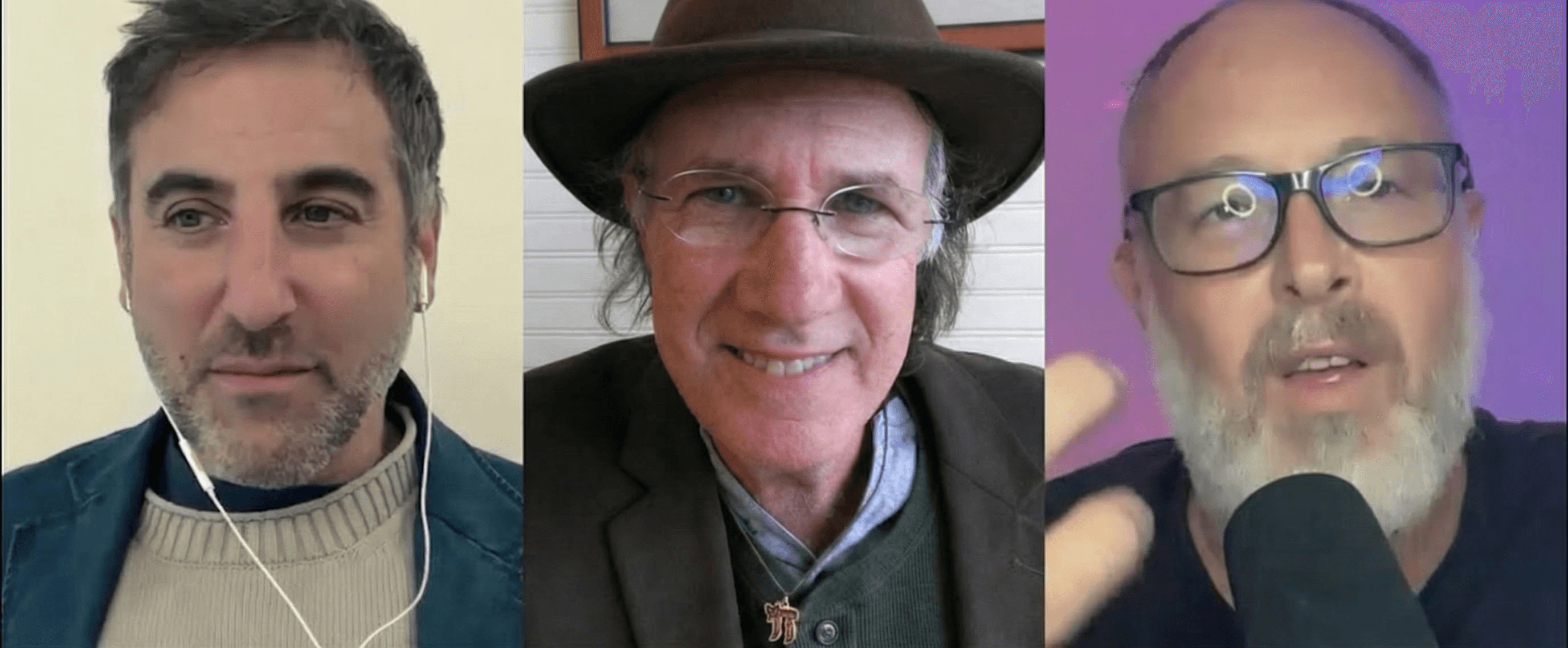
Lio: Hey everyone. My loyal co-host, my friend, my buddy. How's it going down there? Or up there? I don't know. I'm in New York today.
Seth: We just had the mayoral election; we just had the governor election in Jersey. So, Zohran Mamdani—we will see if all the drama and how it will all unfold. There are a lot of different opinions about it.
Lio: They're handing out baklavas, as you like to call them. That's usually the custom.
Seth: We'll see. I'll hold my opinions in the meantime, but change is afoot.
Lio: Oh yeah, I think so. You know how it is. I forgot who said it, but some wise person said, "Geez, I hope he sucks as mayor, because the worst thing that can happen is he actually does a good job mayoring the city." Then that gets him more ingrained among the people, and those who resist him will struggle. When he comes out with some weird anti-Jewish laws—like our old buddy Hitler—everybody was already going to be on his side and against the Jews again.
I'm not accusing him of anything yet, but there is so much circumstantial evidence to show his ties to all kinds of nefarious organizations. Look, a part of me as a former New Yorker wants to say, "You know what? He's a mayor, he's got some revolutionary ideas, great. More power to him." He thinks he can pay rent for two million people? I wish I could be there and get that rent paid for me. He's going to help immigrants? I was an immigrant. I wish I was there and could get helped by a pro-immigrant mayor. For sure, there are a lot of great things that can happen.
It's just that I'm not naive. Having lived in the Middle East most of my life, I take everything that Islamic Shiite people say with a grain of salt. Forgive me for being a little skeptical about their intentions. But it doesn't really matter, because we are not here to really talk about that. We'll talk about that with our guest. These demographic changes sweeping through Europe and New York... what we really care about is the Jews. Where do we fit into all of this? We, collectively—the Jews in New York, in the US, the Jews in Israel. How does that affect us? What does it mean for us at this point in time? And of course, how does this whole thing tie into the main question for which we have gathered here today: How do we solve antisemitism and Jew-hatred?
Our guest is here today. Unless you want to add something specifically about your feeling, Seth? You said you're going to reserve judgment.
Seth: No, I really want to reserve judgment. I have plenty of feelings, but we've been talking about this for years. It doesn't matter; no matter what, no matter where, the pressure will come against the Jews. They don't care what costume or skin suit anyone is wearing. If the Jews don't unite, the pressure will come. It can come from the left. It could come from the right. It can come as a surprise or with an invitation. There's no need to even comment on the situation now. We're talking about a much bigger issue.
Lio: Right. It is bigger. The nice thing about TheJewFunction is that we get to meet all kinds of interesting people. Sometimes you think, "How is this person related to the problem? How can he help us solve it?" But we discover more often than not that each person we bring on adds another perspective. It helps create this picture of who we are as a people, what our role is in the system. Gradually, I think we're arriving at a picture. We're able to clarify who is a Jew, what is the definition of a Jew, and why we have a unique role in the system. Everybody has a role, but what's ours? And how is that connected to solving antisemitism?
This guest is definitely unique. He's been a lawyer for over 35 years. He really has the spirit and soul of an activist bringing positive change to the world. He recently released a folk musical titled Sarah Arthur: The Spiritual Journey of a Jewish American Woman. It explores these themes of identity, resilience, and hope. I think it's going to be an interesting conversation to hear from that unique perspective. Let's give a warm welcome to Alan Graf. Alan, there he is.
Alan Graf: Hey, how's it going?
Seth: Happy to be here.
Alan Graf: Happy to be here. I'm thrilled, actually. I'm married to a Shiksa, and my wife said to me the other day, "Well, you don't practice the Jewish religion. You're not really Jewish." I went, "Wrong. I am Jewish to the core, to the DNA."
My dad escaped Nazi Germany. His name was Simon, and his sister was Leah Graf. They were living in Offenbach, Germany. My grandparents saw the signs and got all their kids out except for one, with fake Polish passports. They said, "We're going to get our kids out." My dad and his sister—my aunt Frida was 16, my dad was about 18—made it to America. At the time, FDR was not allowing Jews into the U.S. Eleanor Roosevelt actually got into a big fight with him over a ship that was trying to dock.
Lio: Yeah, the St. Louis. Are they related to that?
Alan Graf: Yeah. A lot of people think FDR was a great president. He had his strong and weak points. My dad came over here, met my mom in a beauty parlor, and then joined the U.S. Air Force to go back and fight the Nazis. He was a GI. At the end of the war, he found his brother, my Uncle Joe, in a concentration camp. He got there a day early; they were about to exterminate all the Jews in that camp. He saved his brother and brought him back here.
I call that the blessing and the curse of my life. It's the reason I became an activist and a lawyer. I get teary-eyed thinking about my grandparents being led to the gas chambers. It shaped my whole life. I went to a museum in New York City where you can trace your heritage and found out my grandmother had actually worked as a cook for a Nazi military family for two years before they sent her off to be killed. She served the purpose. My grandfather was immediately sent to the camps.
I wake up every morning and think about that. I feel driven. I'm on a mission to make sure that doesn't happen again. My parents felt safe here, but I was raised in Jackson Heights, New York. When I was living there, it was predominantly Jewish and Irish. The Irish went to St. Joan of Arc, and the nuns would teach them that we had killed Jesus. They’d come out looking to avenge God's death. I got beat up a number of times as a Jew. I learned to run my ass off and figure out where all the backyards and fences were. That's how I started my life—with my dad as an escapee, and then fighting antisemitism in New York City, the enlightened town that it claims to be.
Throughout my civil rights career, I’ve fought. When I was in Portland, Oregon, I sued the Portland police. I found out the guy who ordered the pepper spraying of thousands of protesters when George Bush came to town was a closet Nazi. He had pictures of Adolf Hitler in his house. He got married at Hitler's summer home in Germany. He set up a secret memorial for German soldiers in Portland. It was unbelievable. One of his friends came forward and told us this.
I went to the paper. The next day, a car pulled up next to me in Portland, and a guy pulled a gun on me. He said, "You're a dead man." The car chased me around until I ran into a bunch of hardhats. I said, "Somebody's trying to kill me." They said, "We'll call the police." I said, "No, that was the police."
I called the city attorney and said, "This is what happened." They said, "Oh, that couldn't be the police." I filed a report. Four weeks passed, and nothing happened. I had a talk radio show in Portland with about 30,000 listeners. I got on and told everybody, "Your favorite lefty Jewish lawyer nearly got assassinated for suing a Nazi cop." The mayor at the time, Vera Katz, who had escaped from Nazi Germany as a young girl, called up the District Attorney and said, "You got to talk to Graf." They brought me in, interrogated me for an hour and a half trying to blow holes in my story, and finally admitted that it probably happened. They never found out who did it.
I've experienced antisemitism my entire life. But one thing is: it's never shut me up. Every time it happens, I open my mouth even bigger. You can't shut me up. Every time you try to shut this Jew up, I'm going to get louder.
Lio: Alan, when did that happen to you? In the 70s?
Alan Graf: The Portland incident was back in 2004 or 2005. Relatively recent.
Let me tell you something controversial. When I went against this cop, I called the ADL. I said, "I'm a Jewish lawyer going against a Nazi cop. I need your help." A day later, they called me back and said, "We can't help you. The Jewish community has a really good relationship with the Portland police. We don't want to disturb that. You're on your own." I thought, "Where are your principles? Is it all opportunistic?"
Another time, I moved to Floyd, Virginia. Remember Charlottesville, where they had the Nazis marching in the street? Because I'm a constitutional lawyer, right before that, the ACLU called me and asked me to represent those folks to get them a permit. I said, "Hell no. I believe in the First Amendment, but sorry, I don't represent Nazis."
I wrote an article in the local paper saying that flying the Confederate flag is really similar to flying a swastika. Right after that, I got letters in the mail, unsigned, and hate on the internet saying, "Jew, we're going to drive you out of town." I called the ADL again, and they declined to help me.
Seth: There are a lot of fights to fight. You're just looking for fights.
Lio: Are we trying to solve this thing, Alan?
Seth: We could pick a thousand people to sue right now. That's a difficult strategy.
Alan Graf: Which strategy?
Seth: Micro-suing. Going to each neighborhood—sue this guy, sue that guy. It’s never-ending.
Alan Graf: Well, lawsuits are better than shooting people. A lawsuit between the Israelis and the Palestinians would have been a lot better than everybody killing each other. So when people look negatively at lawsuits, I ask, "What's the alternative?"
Seth: I'm not saying lawsuits aren't important. What I'm saying is, what's the end goal? You can move to town and go up against the guy with Hitler memorabilia. You can move to another town and go up against the guy with Confederate flags. You're going to need an army of tens of thousands of people like you. Maybe building a coalition of goodness and quieting them down—overtaking them with goodness—might be more strategic.
Lio: Well, let's hear him out. Alan, you're positioned in an interesting place because you're first generation after the Holocaust. Usually, we have second or third generation. Your parents, did they talk about the Holocaust at home?
Alan Graf: They never talked about it. Every time I asked them, they left the room.
Lio: Fair enough. But it was there, right? You could feel it. So it's fairly fresh. You live in the US, which for several decades felt like a great place for Jews. We have guests who praise the country as the Goldene Medina. Yet, we're seeing a steady rise in antisemitism. It's not going away as you'd expect after the Holocaust; it's picking up again.
The question Seth and I are circling is not just regarding strategy. Did you ever stop and ask yourself: Where is it coming from? What's the root of it all? Is there a central, primordial root? Otherwise, if you have a problem, you have to get to the root before you can solve it.
Alan Graf: You may disagree with me, but I think it's racism generally. It's fear. People fear people that aren't like them. Antisemitism is a type of racism particular to Jews, but you see it against African-Americans, against migrants. It all comes from the same gut deformity in the human psyche. We haven't gotten to a point where we can look at each other as just human beings.
I mean, Arabs are Semites too. Abraham was the father of both. Clearly, antisemitism is irrational. I read a book by Peter Beinart called The Gaza Reckoning. We discuss this at "Torah on Tap" in Asheville. We talk about how we feel about what's happening in Israel. As we say, "Two Jews, three opinions"—more like ten. But the common thread we should be proud of is that we care about our humanity. We don't want to become barbaric.
I'm willing to give Mamdani the benefit of the doubt with a close look. If he starts coming across as antisemitic, he's going to blow himself up; there are too many Jews in New York. I like progressive politics, but I'm realistic.
You were talking before, Seth, about being more positive. I understand that philosophy. I lived in a hippie commune for 12 years, and then another five later—a place called The Farm. I've been trying to live my beliefs as opposed to fighting the system. Fighting the system wears you out.
Lio: I want to stop you there. You spent years in a hippie commune. If it's so great, why aren't you living there right now?
Alan Graf: Because communism doesn't work. You have to have incentives. If there is no incentive, and people put out different energy but get rewarded the same, it's not going to work.
I used to work with the Black Panthers and SDS (Students for a Democratic Society) back in the 60s. Bob Dylan has a song, "I was so much older then, I'm younger than that now." Back then, I knew everything. I saw hypocrisy in their ranks; they were very patriarchal. So I moved to The Farm. It was guru-driven. He used different religions to put together a "hippie religion." At some point, I realized I had lost my free will. I had abdicated my intelligence and decision-making to some other person. I even had to get his approval to marry someone. I thought, "This is wrong."
My mother kept saying, "When are you going to cut your hair and leave that damn farm?" She even sent a rabbi to rescue me at one point.
Lio: So the Jews saved your life!
Alan Graf: Yeah. As I said to Seth, The Farm didn't work because it wasn't really equal. I believe in regulated capitalism now. If it's a totally free market, you have people like Elon Musk taking over. There have to be limitations.
Lio: Just in parentheses, you saw that utopian socialism doesn't work because of the motivation issue. Marx even said his theory was incomplete. We know we want to destroy what exists, but nobody really knows what should replace it. Mamdani ran on democratic socialist ideas.
Alan Graf: Democratic socialism is a big difference. When the government rams theory down your throat with repressive regimes, it blows up. Putin is trying to do that. Democratic socialists are into government-run programs, but they are voted in. That's a huge difference.
Lio: Let's fast forward. Seth and I talk about the shortcomings of socialism. Ideally, it would be great to live in a place where everything is taken care of. The nuclear family is a socialist unit: everybody is taken care of, you don't demand the five-year-old do what the 30-year-old does, and everybody gets what they need. It works in the family. But once you step out of those boundaries, all hell breaks loose.
We say it would be great to live in a society that upholds these ideals. However, unless you fix that "distorted quality" in people you mentioned earlier—unless we work on ourselves first—you can't do any of those things. You'll always have to shove them down people's throats with bayonets.
Seth: In short: If everybody loves everyone, communism is the way to go. Until then, it's not a good system. Love has to come first. We need to start small. Hopefully, we start with the Jewish people—who are one family made up of every color, belief system, and sexual orientation. We need to get this group incentivized to love each other.
You said there is nothing exceptional about Jews, but in every town you lived in, the mayor is a Jew. How is that happening? It's weird. It's not like one town has an Apache mayor and another an Indian mayor. It's always a Jew. My premise is: let's get love going between this small group and see how that affects the system.
Alan Graf: Yeah. Well, we tried that on The Farm. By the way, I'm pushing my album. It deals with these issues. It's called Sarah Arthur: The Spiritual Journey of a Jewish American Woman, a folk musical. The website is SarahArthurProject.com.
Lio: Is she a real person?
Alan Graf: She's a made-up character. In part, she's me out of feeling. In Herman Hesse's Siddhartha, at the end of his life, he talks about the ferry boat taking him to the great beyond. There's a lot of that in there. Her dad, Bernard, escaped Nazi Germany, just like mine. She has an Aunt Frida.
Through this musical, she deals with Jewish identity and hatred. She sees the struggle of Jewish refugees coming from Nazi Germany as similar to refugees now coming into the U.S. I lived in Guatemala for three years and adopted a Guatemalan daughter, so that plays a part.
At 75, I try not to tell people I'm right, but rather ask questions to get them to think. One of the things I'm proud of is the moral structure of Judaism. That's a powerful thing we've had for thousands of years.
I'm not naive about Hamas; it was barbaric. But regarding Israel's reaction... I try to explain to people that Jews know from history that nobody has their back. I get why Israel has to be the "baddest ass" player in the Middle East. If they don't look like crazy mofos, somebody is going to try to blow them up. I really do get that. At the same time, there's an old Randy Newman tune: "Boom goes London, boom Paris, more room for you and more room for me... They all hate us anyhow, so let's drop the big one now." The point is, you can kill and kill, and it's never going to go away. At some point, you have to figure out how to come to peace with your enemies.
Lio: Let me drop a bomb here. We found in studying Jewish history and the sages that the message is not about killing or not killing. You are part of a system. This whole system is a reflection of you—a hologram, or as our sages say, "Man is a small world."
If you want to see peace in the system, you have to make peace in you and between you and the people around you. Someone has to start it, and the ones who are starting it need to be Jews. Like any big change in a system, you need a few cells to start it. You will never be able to stop the wars unless you first focus on peace between us. That's the one thing Jews run away from. We'll help the Blacks, the gays, we'll take up any cause—except talking to Moishe from the other synagogue who I don't like.
If we don't address the root, you get a little respite, and then it's back to the courtroom or back to war.
Seth: Let me put some icing on the cake. There is an emergent thing that happens when this small group called Jews unites. I don't want to go mystical, but it's like a law of nature. There is an X-factor. It's not just groundwork; there is a divine, emergent quality.
Lio: Emergent qualities are things you cannot predict. Like hydrogen and oxygen—put them together, you get water. Where did that come from?
Seth: Without that piece, our argument is incomplete. When the Jews connect, even what's happening here between us—bringing different opinions together with warmth—we affect the field around us. When Jews connect above their differences, that resonates through the system. Peace doesn't mean I wipe out my opinions. It means I have mine, you have yours, but we make peace between them. We say in Hebrew, "He who makes peace in the heavens..." In heaven, fire and water exist together. On earth, opposites extinguish each other. We need to find love above the differences—between LGBTQ, Ben Gvir, and everything in between.
Lio: And it's not easy. It takes work 24/7. It's not like the hippies where we say "let's love each other" and then discover we are egoists. We have to work on it. Jews are the only group that had this experience of being "as one man with one heart." We have to tap into that.
Alan Graf: I'm down. I'm doing our record release party at the Asheville Jewish Community Center on November 16th. If anybody from Israel is listening, we'd love to come perform it.
I may say something controversial here. I'm not a fan of Netanyahu. I think what happened on October 7th was horrible, but how Israel reacted hurt Israel's soul and Jewish history. Worshipping a state can be like idolatry. If you worship a state more than your morals, it's a conflict. I think Israel has to be the leader in bringing peace together. We could show the neighbors, "Hey, we're the good guys. We're going to defend ourselves, but we're generous." The Jews have the strength to do that.
Lio: I would encourage you to come to Israel sooner than you think. You'll find that the calamity of October 7th actually stopped a potential civil war. The reaction of the people is a renewed sense of unity and mutual responsibility (Arvut). Forget the politicians and media. The people, especially the young, are coming together. There is a conflict between a majority starting to see the necessity of unity and a small minority holding onto old power.
We want to inspire Jews to do the work. Not to sit back during a ceasefire, but to focus on bringing us together.
Alan Graf: Sounds like a good plan. You know, what I like about the law is that I get to make my argument, and the other side does not interrupt. Then they get to respond. It's orderly. If we were better at that—listening carefully enough to rebut—it would be better.
Lio: It was our pleasure, Alan. We usually ask our guests to read a quote from the sources. This is from Likutei Halachot, Rule Number Four.
Alan Graf: "The vitality is mainly through unity, by all the changes being included in the source of the unity. For this reason, 'love your friend as yourself' is the great rule of the Torah."
I agree with that. I have enough of a flower child in me to hope that happens someday. I have six grandkids, and I think, "What earth am I leaving them?" We have to end war.
Lio: Do we have universal healthcare in Israel? Yes, Israel is a little bit socialist—healthcare, education.
Alan Graf: So you follow Mamdani in Israel then?
Lio: No, he follows us!
Alan Graf: I appreciate you having me on the show. It reminds me to go back and read my Jewish traditional books. I hope you go to SarahArthurProject.com and check out the album.
Lio: Thank you, Alan. I encourage everyone to listen to it. And anyone who has doubts about Israel, come spend time with the people here. We are TheJewFunction. Like, subscribe, hit the bell, and leave a comment to help with the dreaded algorithm. Thanks, everyone.
Alan Graf: Take care. Good meeting you guys.