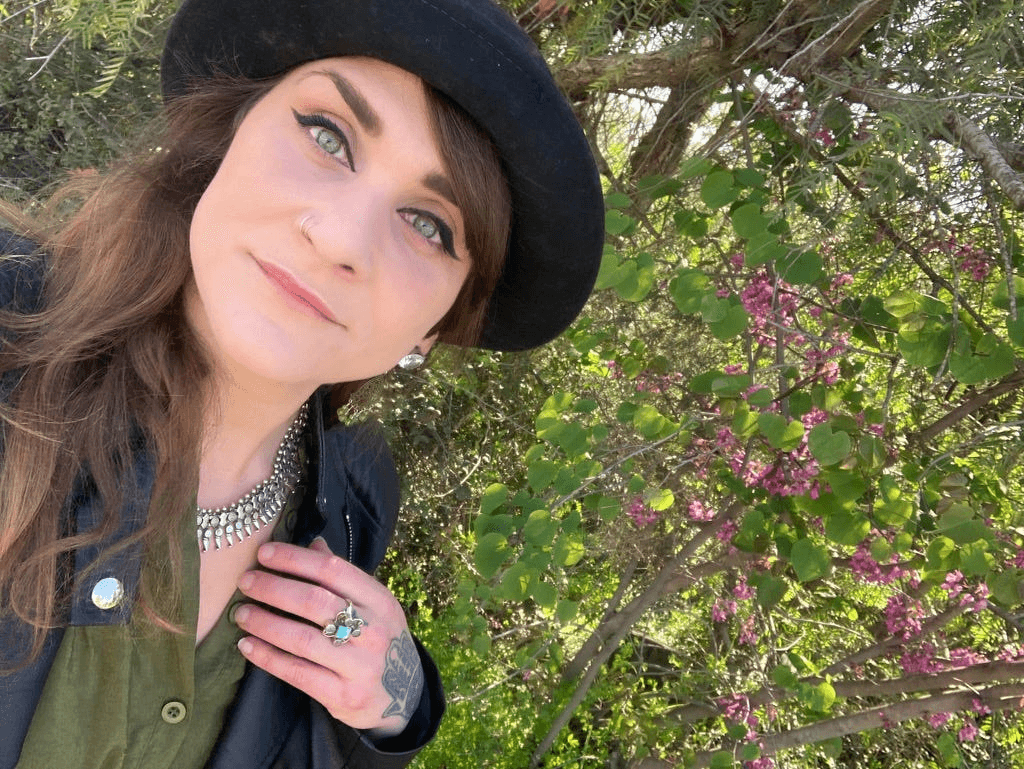
Lio [01:35] Hello everyone, welcome to TheJewFunction. I'm very happy to be here today — I'm Lio, this is Seth. With us today is a very special guest. Her name is Ateret Violet Shmuel. She is the founder and director of Indigenous Bridges, a global initiative dedicated to uplifting indigenous communities and fostering unity across cultures, traditions, and identities — which we love. Unity, anything with unity, we dig. From her content, I also gathered that she comes from a very liberal home, not particularly religious. She started as an extreme liberal, went into college, got even more radicalized, and then managed to use that energy to propel herself above that while retaining her liberal values and her deep human connection. That's what we really like about her. We'll hear all about it from her. Hi, Ateret. How are you?
Ateret [02:49] I'm wonderful. Thank you so much for having me.
Lio [02:53] On TheJewFunction, we really want to solve anti-Semitism, and we feel a lot of it has to do with helping people change their perceptions. I hear in your clips you talk a lot about perceptions — how we have certain perceptions and how these can be manipulated. I think if people live long enough, they begin to realize that the way we perceive the world is sometimes a far cry from what's actually happening in reality. We're influenced by so many things. Our lenses are clouded, cracked, smudged. We see the world through a lens that's been placed in front of our eyes, and most of us stay in that worldview and get manipulated by all kinds of forces. I'm curious — maybe you can tell us how you found the strength, the courage, or just the ability to lift your head from whatever programming you came with and choose a different path. Give us a little background, and then how that shift happened.
Seth [04:26] Maybe start in university — who you were, what was going on, what you experienced, and how that shift happened.
Ateret [04:37] Let's see where to start. I grew up very, very far left. I come from a family of activists and academics, and human rights was always a big piece of our upbringing. It was also a very big piece of our Jewish identity. We were those Tikkun Olam Jews — the ones who don't have much connection to Judaism outside of that idea, which gets taken out of the context of Judaism and generalized into human rights and social justice everywhere. That unfortunately often leads to holding pretty anti-Jewish views, ultimately, in the West.
So I was a radical. I grew up in the punk scene and organized for a lot of very far-left organizations — socialist, communist, anti-racist, anti-fascist organizations. I organized Antifa demonstrations, and many other things. I actually started a couple of NGOs — one of which dealt with combating racism, bigotry, and colonialism — while I was still in college. Then I ended up going to a very liberal Ivy League.
Seth [06:20] You did all that in high school?
Ateret [06:22] I was organizing for social justice stuff in high school. Yeah, my upbringing was a little crazy.
Lio [06:40] Then you went to Brown?
Ateret [06:42] I went to Brown. By the time I got there, I was already radical. But I was also studying two degree paths simultaneously — psychology and comparative religion and Middle Eastern history. My professors... I grew up rough, pretty hard. My childhood was not so simple — like most people of my generation who ended up in the punk scene. It was a big deal that I made it to an Ivy League. And once you get to a place like that, especially if you come from a place where people don't think you can make it, you really look up to those professors. You view them as gurus. And a lot of the information I was getting from those professors was pure Qatari anti-Semitic propaganda. I didn't understand that then, but now in retrospect I see exactly what it was.
I became even further radicalized. I ran an organization that was supposed to be the progressive middle path to the Israeli-Palestinian conflict — with people like Cornel West and Rabbi Michael Lerner and so on. We won't name that organization because I don't want to give it any more airplay. I was involved in a lot of that internalized anti-Semitic nonsense because I've always had a very strong moral compass. I'm violently allergic to injustice. A lot of that, I think, was informed by my Jewishness — my Jewish upbringing, my Jewish soul.
It wasn't until I was out of college and working in human rights that I realized how much of the information and narratives I had been given in university were absolute nonsense, completely drenched in anti-Semitic propaganda. My real turning point was the Marmara incident in 2010. That was my real "aha" moment, because it was so obvious — and I was privy to all of the information because I was working in human rights. That really was my big pivot. I started using whatever currency my voice had to begin pulling apart the stories and narratives people were spreading about Jews and Israel. But up until that point, I didn't realize just how much of it was lies.
Lio [10:13] You realized it was lies because you were working on the inside and got to see the communications around publicity stunts like the Marmara. Just so people know — maybe give a little context.
Seth [10:27] And why did you see it when the people around you didn't?
Lio [10:31] Hold on — just a brief parenthetical so people know: in 2010, there was a convoy of ships led by the Turkish vessel Mavi Marmara that attempted to breach the Israeli naval blockade, much like Greta and her group tried to do more recently. When Israel boarded the ship, there were violent clashes and nine activists were killed, which sparked a major controversy and furthered the narrative of "Israel bad, everyone else good."
Ateret [11:20] The thing about the Marmara was that I was active in human rights at the time, so I understood who the people on that vessel were. They were not activists in the sense that I'm an activist. They were people associated with Islamist terrorist organizations who were involved in human trafficking, sexual violence, and the oppression of indigenous minority groups. It was sold to the world as a humanitarian vessel — much like the recent flotilla attempts — even though there was essentially no humanitarian aid on board.
I knew about the people on it and their terror ties, and I was horrified. My moral compass is pretty consistent. The fact that they were calling themselves humanitarians was laughable. And the fact that when the IDF boarded the ship, the soldiers were unarmed — they had paintball guns, no live ammunition — and were attacked with pistols, pipes, and knives. Everything was recorded; they had body cameras even back then and released that footage to the public. Unfortunately, as we still see today, it took a little while to release it. By that time, the narrative about Jews being evil had already spread around the world. But the soldiers were attacked by Islamist terrorist supporters on that boat who were trying to break international law — and then they fought back.
Lio [13:40] So back to Seth's question: how did you see it when so many others didn't? Even today, after October 7th was so thoroughly documented, people still refuse to see it. When you have a certain lens through which you see the world, it's very hard to remove it.
Seth [14:12] And look at the contrast — the public outcry on college campuses over what's happening in Gaza versus the silence over what's happening in Iran. How is it that people don't see it?
Ateret [14:28] There's a lot to unpack there. First of all, in the Western world — and I feel a little more comfortable speaking about America specifically, since I spent more time there — you have people who don't feel a sense of belonging. Their experience of life feels kind of empty. American society is very individualistic, and people are tribal pack animals. It's packaged into our biology to be part of something — a community, a tribe, a family. That doesn't exist so much in Western society, especially in America.
So you have people who are empty inside, desperately seeking meaning, belonging, and connection. That's a deeply human need, built into our DNA. And in lieu of the traditional things that held that space — religion, family, community — people seek it out in sports, in politics, in political alignments. They become deeply emotionally invested, their identity connected to a political movement.
Seth [16:07] It becomes tribal.
Ateret [16:09] It's that tribalism that gives them a sense of belonging, purpose, and meaning. And even if that group shifts its morals, ethics, or belief system in a way that's incompatible with an individual's own ideals, if they feel emotionally invested and attached enough to that party or movement, it's very difficult to pull themselves out of it. Because that means unraveling one's own identity, which is not something the average human being is very comfortable with.
If your entire identity is built around "I'm a leftist, I'm a good person, I'm a humanitarian, I'm the best of the best" — and there's a lot of ego in the left: we're the academics, we're the ones who question things, we believe in science, we reject primitive belief systems — to have that be such a big part of your identity, and then to watch an anti-Semitic, anti-Zionist, anti-Israel sentiment creep in and become a piece of party politics on the American left... the American left has not done enough to challenge that in any way, shape, or form. And so now it is rampant. You have people who watched with their own eyes the sexual violence, the kidnapping, the slaughter of children, the murder of innocent human beings on October 7th — and still couldn't go against their party lines.
Lio [18:04] I just came across a great book by Lisa Crone called Story or Die — she's a script and story writer, used to work in marketing. She really breaks down the idea of story and says, I'm paraphrasing, that people resist changing their minds because doing so would destabilize the internal story they use to belong to their social group or tribe. The story is deeply tied to identity and survival instincts in the brain, so conflicting evidence triggers emotional resistance—
Seth [18:45] —rather than rational reassessment. There's a book called Ordinary Men, about a German police force. These were not fanatical Nazis — they were ordinary, middle-aged, working-class men. The book meticulously documents how they committed atrocities because of that group dynamic — like the Stanford prison experiment. Once you belong to a tribe, that need is so strong that even presented with facts, you can't move from your belief.
Which raises the question: wouldn't it be wonderful to create a tribe around a different belief system — one that gives people a home? Instead of just fighting something, because you can have all the facts in the world and it won't matter. People are willing to die, willing to go to jail, even when they're totally wrong. Where's all the outrage on the college campuses over what's going on in Iran?
Ateret [20:17] That's actually consistent — the Iran and anti-Israel thing are connected. These people actively support that regime, which is why they don't protest against it.
Seth [20:33] Toward something practical: if we crystallize this point, then a better future means having a tribe that's holistic — that includes everyone, gives them a sense of meaning and purpose, and isn't about harming others. Some kind of community connected to thousands of years of history that's the foundation for civilization, something with a messianic, beautiful vision of brotherhood. Wouldn't it behoove us to work on creating that tribe?
Ateret [22:06] It would definitely be beneficial to the entire world if people could find meaning without oppressing or harming others. But why doesn't that naturally grow out of progressive circles?
Seth [22:24] Why isn't that kind of thing growing out of all those progressive circles you were in?
Ateret [22:31] Because progressive circles are actually very high-judgment, very critical spaces. There's this story we all told ourselves about being the most humanitarian, most empathetic, most compassionate people — the ones who care about human rights. But it's really, when it comes down to it... I genuinely thought, for a very long time — especially before October 7th, and even just after — that so many people I grew up with, people in the academic world, had just gotten swept up in a wave. Being part of a movement is intoxicating. If you've ever been to a huge demonstration, part of that ocean of people all focusing their energy in one direction — it's incredible. And that's an experience a lot of human beings lack without community.
I mistakenly believed that most people care about truth the way that I do, and that most people hold themselves accountable and question themselves the way that I do. Part of why I got out of that world is because I genuinely care about empirical truth, and I'm always willing to examine my beliefs, challenge them, see whether they're still valid, and reassess. A lot of people can't do that.
Lio [24:58] In psychology, I think that's called metacognition — thinking about thinking, evaluating how you relate to things. We had a wonderful former far-left activist here in Israel who switched sides, and she says she always likes to be right — and in order to always be right, she has to change her mind constantly.
Ateret [25:31] Exactly. To always be right, you have to allow new information in and assess whether it challenges your existing belief system. You need to be able to admit when you're wrong.
Lio [25:46] Some would say not everyone is capable of that.
Seth [25:55] It's a big ask. We have to lower the bar. How many people like Ateret did what you did?
Ateret [26:04] I know a lot of people who've seen similar things and come from similar backgrounds and backed out of it because they understood how toxic it was. Not all of them go into fighting it the way I have. I think part of what fuels me — it's a compulsion, not even just a desire — is that I genuinely have this unkillable faith in humanity.
It's been damaged over the last two and a half years. A lot damaged. But all the faith I've lost in humanity, I've shifted toward my own people. And our nation is amazing.
Seth [27:20] Tell us.
Ateret [27:21] We do such wonderful things. I've been endlessly impressed by the uncrushable Jewish spirit — by the desire to bring light into the world even in the darkest of times, to dafka do that. The way we come together, the way we support each other — whenever we're in crisis, even if we hate each other, even a right-winger and a left-winger screaming in each other's faces, the second there's an air raid siren, they grab each other and help each other's kids into the bomb shelter. That's Am Yisrael. There's something that ties us together. We're ridiculous, obnoxious, crazy, stubborn people — but we're also hilarious and brilliant and wonderful and kind and good. We see that time and time again. The last two-plus years of war have really brought that out in our people, despite what the media tries to wedge into our society. On the whole, if you just look around you, you see achdut as opposed to hatred.
Lio [28:30] I agree. Unfortunately, I also see the cracks in the wall. It's still not—
Seth [28:42] She was building back up! Let her have it.
Ateret [28:48] Hey, I can have my beliefs challenged.
Lio [28:50] We're just warming up. I want to take half a step to the side and ask you something more personal. You said in the beginning that you came from a home that believed in activism and Tikkun Olam — correcting the world, following the moral compass. What do you think people are actually trying to correct when they say Tikkun Olam? What are we correcting?
Ateret [29:50] I think everybody has their own tikkun — each one of us has this little piece of the world that we're uniquely qualified to affect change in. It's different for everyone. There's something that says you're born at the moment God decides the world can't exist without you. And there's something from the Chabad world — I'm paraphrasing — to the effect that if you see a piece of the world that's broken and it really bothers you, that's probably your job to fix it.
Lio [30:42] So a lot of people wake up in the morning — people who grew up with this good ideal of tikkun, of correction — and the question is: how do they know what needs fixing and how to fix it? I see a world full of people with clashing beliefs on what needs correcting. Isn't it equally dangerous to just roll up your sleeves without the proper understanding? You could hurt yourself, you could hurt others. How did you know what needed correcting? Do you think you knew?
Ateret [31:48] It took me a while to find my niche, truthfully. I worked in human rights generally for a very long time — it's a very big world with a lot of brokenness. My academic background was actually in the Arab-Israeli conflict. When I realized what a dead end it was, that no matter how much I poured into it, it was going to make zero impact, I refocused my energy toward indigenous communities.
Lio [32:24] Because you thought you could help them more?
Ateret [32:30] A few reasons. I've always worked with indigenous communities and felt an affinity for other indigenous tribal nations. There's something really beautiful and relatable, especially as a Jew, to communities that have these ancient traditions — faith that transcends time and space, ancient cultures, languages, dress, traditions, ceremonies. Just like us.
The funny thing is, I actually became religious as an adult, and part of my return to Judaism was because of my Native American friends saying to me, "You also have this. What are you looking for? You're Jewish. Look at your own people." And they were right.
Even before I understood that about my own people, I felt it — this sense of connectedness to our traditions, to these ancient words we say before we do things, the ritual, the connection to our land, our nation, our names. And I saw that same thing in other indigenous people and really related to it.
I also noticed that indigenous communities were disproportionately targeted by genocide and colonialism, and were completely unrecognized and unserved. There was no representation, no real research, no holistic activism focused on them.
Then I noticed — starting about fifteen years ago, though it probably began in the seventies with the PLO — there was a very intentional funneling of anti-Semitic propaganda into indigenous communities by Qatar, Iran, and the PLO. These community spaces were being hijacked by Arab and Islamist colonialist powers who were appropriating the language of indigenous rights to weaponize it against Jews — trying to paint Jews as white European colonialist settlers who illegally stole indigenous land.
I noticed there was no one in these communities who really knew enough to push back against it. Indigenous tribal nations — Jews included — after a huge historical trauma like genocide tend to circle the wagons, face inward, and not interact with the outside world so much. We were focused on healing our own communities. So we didn't know much about each other.
I realized there were a lot of good people who had been given really bad information, and that if they understood the truth, they would be horrified and would reject it. In my experience with indigenous communities specifically, that has been the case. When they actually understand they're being manipulated by a global colonialist empire, they tend to reject it.
So I started Indigenous Bridges by bringing all those scattered voices together to work collaboratively.
Lio [37:46] This is great work. How does it compare to what's happening in the Jewish indigenous community?
Ateret [38:01] Jews generally don't speak of ourselves in those terms. People have started using the concept of indigeneity partly through the influence of my team. But it's a really important question, because "indigenous" is a word that gets thrown around a lot — especially on the left, it's a buzzword. For the purposes of my work in international indigenous rights, we have a very narrow definition, which is critical, because people redefine words to mean whatever they want.
To be an indigenous people by our definition: they have an ethnogenesis — a coming-about of a people from within a specific land. They have connections to that land that predate colonial contact. They have a unique language, culture, dress, tradition, and religious or spiritual framework connected to that people and that land, along with the desire to pass that on to future generations. That definition is narrow enough that some communities clearly fit it — and some clearly don't.
Lio [39:42] I would argue that Jews are indigenous to an ideology, not just to a land. I coined that right here — you can take it.
Ateret [39:56] That's an interesting framing.
Lio [39:59] Because we are a hodgepodge. We don't come from one land. A group gathered around Abraham in Babylon, but others came from other places, and then we moved around a lot, and only settled in Israel after going through a good portion of our evolution as a nation. That journey has been part of our evolution too.
Seth [40:26] Nevertheless, three thousand years ago. There's still something to say for it.
Ateret [40:34] There's also a slight difference between our two narratives. We have the biblical story — our cultural story in the Torah, our sages, our liturgy — and then we have history, science, archaeology, genetic studies, and history written by others, which actually shows that we're from this land.
Do you know that archaeology shows the Canaanites were occupied by Egypt? There was a strong hierarchy of haves and have-nots. At some point the have-nots overthrew Egyptian rule and began to live outside the cities, adopting a more agrarian lifestyle. The pottery changed. Society became more egalitarian. It's entirely theoretically possible — although it might be considered heretical in some circles — that our story of Yetziat Mitzrayim, the Exodus from Egypt, is actually our story of freeing ourselves from Egypt's colonialist oppression. And our genetics show that we are from this land. Our coming-about as a people is entirely tied to our return to the land of Canaan, the land of Israel.
Lio [42:22] We're not questioning that — the land of Israel plays a very important role in our evolution. We're simply saying that because we've existed for thousands of years as a cohesive group formed around an ideology that traveled with us no matter where we went, and that kept evolving with us through every phase — whether those phases happened exactly as described historically or not — it left a certain mark on this group that was evolving. And the proof of that is the existence of this group.
The problem is that we predate the scientific and historical methods — they evolved while we were evolving as a nation. That's why it's limiting to say "we only look at science" or "we only look at the Bible." You need a picture that's all-encompassing. And the only thing that all-encompasses the Jewish people is the story of who the Jewish people are.
Which brings me to the great question we ask everyone: Who are the Jewish people? What are they? How would you define this group that you obviously belong to? How would you explain their anomalous existence throughout history — their disproportionate influence on the world, the extraordinary attention they attract — to an outside observer, an alien who came and asked, "Who are these people?"
Ateret [44:18] I live a bit of a double life. I have my geopolitical, analytical, tough work in human rights, social justice, and indigenous rights. And I also happen to be an Orthodox Jew. And I think my Judaism has really given me the strength to bear witness to and assist in situations involving some of the worst human rights atrocities in the world. I've seen horrible things. I often end up assisting communities experiencing genocide, which is not a simple thing to bear witness to. I carry all of it with me — I can still see the names and faces of victims of crimes against humanity I dealt with fifteen, twenty years ago.
To have a foundational belief that there is a purpose, and that things are happening the way they are for a reason — that has been one of the things that has allowed me to keep showing up. So it's hard for me to separate it.
I can define Jews publicly the way I do in my work — as an ethno-religious indigenous group originating in the Southern Levant, sharing an ancient culture and ties to our land dating back four thousand years, with an incredible, unique theosophical and legal system that we've carried with us — even made portable, as you mentioned — when forced out of our land into diaspora. But it's hard for me to talk about what's allowed our nation to survive everything it has survived without bringing Hashem into it a little.
Seth [47:02] Please bring Him in. From the worldview that Lio and I come from, informed by Baal HaSulam — the great kabbalist who wrote the Sulam commentary on the Zohar — all humans have a physical body made of the same material as leaves, trees, ants, and rocks. But there's another piece — let's call it a spark of God, the light of Bina — that comes down and dwells inside everyone. For most people it's completely covered. It's this urge to return to the root of the soul, to unity. Some people it starts to awaken, and they start searching. Some people, like the three of us, it doesn't let them rest. And the Jewish nation — when Abraham started this movement in Babylon, it wasn't from one genetic pool. It drew from all the groups there — all the people who had this restlessness that wouldn't let them rest. Those are the people who went out with Abraham. So the Jewish tribe is the vanguard of humanity — not just of the Land of Israel, but the first ones pulled toward this thing. And I want to gather enough of us together where that becomes a home — a home to grow that, live in that, explore and understand it.
Ateret [50:17] For people or for Jews?
Seth [50:19] The Jews have the role — but ultimately it's for everyone. And let's not even get into the lost ten tribes. Of all the indigenous peoples you're researching, who knows how many of them may be Jews in some form or another. If ten of the twelve tribes are lost, the number could be half a billion, a billion people. But the Jews are positioned to lead, because we've been compressed through so much intense scrutiny across all the generations — we're just leading the pack toward where all of humanity has to go.
Ateret [51:26] For me, becoming closer to teshuva and returning to my Jewish roots was an act of decolonization. Re-indigenizing. Returning to our traditions and our wisdom and our people — that is a radical act of decolonization.
It's interesting, because a lot of the Jews who end up gravitating toward my work come from similar backgrounds — from the far left, or from completely unaffiliated Jewish homes. People who've been fed this crazy narrative that Jews are white European colonialist settlers, and who know very little about what being Jewish actually means. Whatever version of Judaism they've been given has been this watered-down, convenient, fake thing that has no power. It doesn't pull you in. There's nothing that lights the ember of the soul ablaze.
Seth [53:03] But going full Haredi probably isn't going to do it either.
Ateret [53:06] There's a whole spectrum of Jewishness. Our tradition and our people have an enormous range of color and flavor. I've found what really speaks to my soul within the Chabad, Breslov, Carlebach, and Rav Kook world — a kind of neo-Hasidic space. On my dad's side, we're Chabad lineage going back generations.
Seth [53:50] You grew up like that?
Ateret [53:51] Actually no — I grew up without any Jewishness. My father passed away at 93 — born in 1932, he passed away this past October. He was very cerebral, intellectual, idealistic — a dreamer. After the Holocaust, he lost his faith and his connection to Judaism. He also needed everything to make intellectual sense, and that doesn't always happen. We don't always get neat answers. So we grew up without it. I didn't even know what it meant to be Jewish until my late teens, when I met someone who grew up in a Chabad family and had left for a while.
Seth [55:14] You met her in the punk scene?
Ateret [55:17] Yes. She's the reason I really became a baalat teshuva — she planted the seed. She actually lives in Israel now too. She'd gone off the derech for a while and found me because I was as off the derech as you can get — I didn't even know the derech existed.
In high school we'd stay up really late learning these incredible things, making art, going to punk shows, making really bad music. At some point she brought Chassidut into it, and it was like an experience I'd never had before — like feeling my soul. Nothing else had ever touched my soul like that. Once that happened, all the pain and violence and craziness I'd grown up around — it just didn't have the same draw. So it was a very slow process of becoming religious.
I haven't really lost my edge, by the way.
Lio [57:08] Good — we need the edge. That's part of it. You don't have to let go of those things. Every Jew comes at Judaism from their own unique angle, and I think that's intentional.
So — taking a step back and looking at the whole picture: from all the work you've done and are doing, why do people hate the Jews? I'll just preface it by saying the last guest we had—
Seth [57:54] —took us an hour and a half to get there.
Lio [57:58] That's okay. The last guest said that when you talk to people one-on-one, they don't actually hate. You can even get along with the most seething anti-Semite one-on-one.
Ateret [58:20] That was my experience for many years, but I think things have changed.
Lio [58:24] Really — that was or wasn't?
Ateret [58:26] That was my experience in the past. It is no longer my experience.
Lio [58:30] Interesting. He said that even the biggest anti-Semites just need a Jew next to them. Everybody needs a Jew in their life. Those who direct the herd of hatred — they just don't have a good Jewish friend. But the question really is: why is this still a thing? We've heard all kinds of answers on this show. If you look at history as discrete pieces, you can say antisemitism existed because of this in one era, and because of that in another. But when you try to connect all the dots and ask why it persists — people are born and die and born again, and yet this thing never gets purged out of humanity's wash cycle. What did you find?
Ateret [1:00:04] There's the tachlis — the geopolitical, sociological, psychological answer. And then there's a Jewish answer, a spiritually Jewish answer.
Lio [1:00:19] Give us the answer that helps solve the problem.
Ateret [1:00:22] We need to be Jews.
Lio [1:00:28] Nice. Which means...
Ateret [1:00:36] It's hard to say this because every time someone brings it up — and it is such an integral part of Jewish tradition, it's what our sages have always said, it's in the Torah — it can sound uncomfortable from a standard Western universalist perspective. But if we're not doing what we're supposed to be doing, if we're not living up to our purpose, Hashem kind of steers us back into shape.
Seth [1:01:13] Let's say it's more like gravity. It's not some jealous God in the sky. It's more like: you get thrown in the water, and the water isn't going to be merciful because you have a family. There are laws. If the Jews are the vanguard of humanity — if we can do what we're intended to do — not only will it be good for us, it will be good for the whole world.
Ateret [1:02:09] That is a hundred percent true. But I also want to say that anti-Semitism, from a geopolitical perspective, has always existed across all sides of all political spectrums. And it's something people don't understand, because it mutates based on what society finds most vile at any given moment.
Right-wing anti-Semitism — at least in the American context over the last fifteen years — has been easier for people to identify. It generally shows up as neo-Nazi, white supremacist thinking: the belief that Jews are those foreign, rabble-rousing Middle Eastern socialists who will stop at nothing to overthrow the established order. So we must get rid of them.
Left-wing anti-Semitism paints Jews as white European colonialist settlers who illegally stole indigenous Palestinian land and are committing genocide, apartheid, and human rights atrocities — responsible for wars, exploiting minorities, responsible for the slave trade, for racism, and so on. Both are nonsense.
But the Jew functions as an effigy. Much like Christians created the scapegoat of Jesus, we take on the role of bearing humanity's sins. Whatever a society doesn't want — their biggest guilt, their deepest shame, the things that pain them most about their own crimes — they project onto us. And so we've had to deal with this shape-shifting hatred for as long as we've existed.
And every time we don't have sovereignty — every time we don't have autonomy, our own land, our own army, our own police force, our own way to protect ourselves — we're at the mercy of all these forces projecting their sins onto us, which has been a disaster historically.
Now that we have that — now that we've regained sovereignty — we've done this incredible feat of throwing off not just British colonialism but Arab colonialism, both Christian and Muslim colonialism, the two main colonialist forces in the world. We carved out this tiny sliver of our ancient indigenous land, brought back and revitalized our ancient language, unified our nation from the four corners of the world — which is, you know, biblical. We're now uniquely positioned to do the rest of the work, which I think is returning to who we're supposed to be.
Lio [1:05:53] Beautiful — now let's hear the practical part. There are thousands, hundreds of thousands, millions of Jews listening right now — give them a short list. What do they need to do?
Ateret [1:06:28] I'm not sure I feel qualified to—
Lio [1:06:49] You're very qualified. Let me make it easy: the premise is simple. What we've been doing is not working. The way we've approached our Jewishness — Orthodox, secular, everything in between — is not fully working. The way we've handled anti-Semitism is not working. Something has to change. And we're sitting on thousands of years of good evidence. Our sages left us a very clear thread. So based on all those clues — what might we add to our lives, our attitudes?
Ateret [1:08:27] If we believe what is passed down in our traditions, there is a very clear directive that Hashem has given to our nation, over and over again, ad nauseum. And if we're to learn from our past mistakes — why did we lose the First Temple?
Lio [1:09:04] We say it on this show all the time. It was always unfounded hatred, turning against each other.
Ateret [1:09:16] The First Temple was lost because of avodah zarah — idolatry. We tried to not be too different. To blend in. To assimilate. To not inconvenience others with our uniqueness. We just wanted to be like everybody else. Like teenagers who just want to fit in. We were turning away from the source. We are given this unique role in the world — to be the spiritual leg upon which the world rests. And if we don't take that seriously, the world crumbles in on us. Like a table whose legs aren't stable.
And the Second Temple — we lost it because of sinat chinam, baseless hatred for each other. And we only have to look at October 7th to see all of it clearly. As we approached October 7th, Jews were turning against Jews — screaming at each other, close to civil war. It was insane and so painful to watch.
It got to the point where people had replaced religion, culture, and family with these external political spaces. I think it was Rabbi Daniel Katz who said something that has stuck with me: Jews are not meant to be red or blue. We're not meant to be Democrat or Republican. We're meant to be Am Segula — the purple space in between, the middle line — because our political system is supposed to be Hashem. Our political system is supposed to be Judaism.
Lio [1:11:57] Just a brief note on that — there's a nikud symbol called a segol, three dots. It represents the right line, the left line, and the middle line — which is the path the Jewish people need to follow. It's called segol because of this very concept.
Ateret [1:12:43] That's the crazy thing — how everything is interconnected. Everything. It's like God winking at you.
Seth [1:12:51] And with the segol — the purple being blue and red combined. It's incredible. Everywhere we look.
Lio [1:13:05] There was a religious molecular biologist who found that the DNA double helix — counting the molecules between each bridge — follows the sequence 10, 5, 6, 5, repeating: Yud-Heh-Vav-Heh. Some people hear that and say it's mysticism. But for those who are open to it—
So — finish your stream of thought. What's the concrete advice? What do we rebuild? What do we do?
Ateret [1:14:37] If we look at October 7th — our tradition tells us that on Rosh Hashanah the Book of Life is opened, on Yom Kippur the Book of Life is closed, and on Shemini Atzeret the judgment is passed down. On Rosh Hashanah we were screaming at each other's faces. On Yom Kippur, the worst thing I've seen happen outside of a genocide took place within our own nation — Jews attacking Jews on Yom Kippur. And on Shemini Atzeret — October 7th — our nation faced the worst genocide since the Holocaust.
And it was a slap across the face that made us realize: that's my brother, that's my sister. These are my people. I love these people and I will fight for these people. The achdut that took place after October 7th was messianic. It was insane. It was beautiful.
And yet we have this recurring problem: when we're attacked from the outside, we hold each other's hands and fight together. But as soon as there's no external enemy, we fight each other. So I think one of the most important things we need to learn is how to see the nikudat hatov in one another — the point of goodness. Rebbe Nachman teaches that there is a spark of ultimate goodness in absolutely every single human being.
Seth [1:16:26] That's the same point — yes.
Ateret [1:16:31] When Hashem breathed life into us, Hashem breathed of Himself into us. So we have this faculty created from the essence of God within each of us — we are this interesting combination of organic earth material and something completely holy and divine, a creative spark that is constantly animating and reanimating the world.
When we get caught up in trivial things — political affiliation, external tribalism — when we replace our indigenous traditions with someone else's frameworks, we sometimes lose the ability to see that spark of God in one another. When our ideology is not our own — when we've allowed a colonized mentality to take hold — we lose the ability to see that spark.
So I think the most critical thing for the healing and evolution of our nation is figuring out how to truly love each other. To see and recognize the incredible beauty in one another. We are different pieces of the same body — you might be the ear and I might be the fingernail, but we're on the same body. We need to figure out not just how to tolerate one another, but how to love, appreciate, and work together.
And if we look at our traditions, they tell us very much what we're supposed to do. There are so many entry points into Jewishness. Everybody's soul is at a different level, and everyone relates to God and to each other differently. I don't feel qualified to tell people what to do, but I can tell people what I find most powerful — and that's kashrut and Shabbat.
Living in this mindful way where every piece of what we do is elevating the mundane into something holy. To take food or drink and recognize its source, to ingest it in a way that elevates ourselves into something bigger. To see the phenomenological, material world as an opportunity to interact with God — that is beyond powerful. It's a form of inner cultivation, much like Buddhist meditation or any of the great mystical traditions. Ours exists too.
If we can tap into something simple but fundamental — Shabbat, kashrut, the chagim — even small things like lighting Shabbat candles — little things that pull you back into the rut our ancestors have carved, these things that transcend time and space, they really change our trajectory entirely and add so much to our lives.
Lio [1:21:11] You said all the right things. That's the whole point — just to remind ourselves of these things.
Ateret [1:21:32] Limud Torah. Learning. So many Jews know nothing about Judaism — what we believe, what we think, where we come from, what our ancestors did. Just learning about our traditions is so powerful.
Lio [1:21:49] It's hard to look inside when there's so much noise on the outside drawing your attention. And "inside" means inside yourself, inside your own people. You sometimes have to take the long path before you can take a good hard look at yourself. We've had people on this show who vehemently reject the idea that we have any special role in the world. But you can't — it's all interconnected. Either you find your niche to correct, or you don't. The only real difference is that what you need to correct is actually just how you relate to everything else. It starts there. And especially how you relate to your fellow human being. That's the only thing any of us can really change. You've had your boots on the ground, your sleeves rolled up — and you saw what was broken, and then you realized you had to start with what was maybe broken inside yourself. That was beautiful. It brought it all home.
Ateret [1:23:46] True. I also think people don't recognize their own power. They've been stamped down, stripped of it. They don't recognize what incredible, majestic miracles each of us is. What it took for us to come into this world at exactly this moment, exactly the way that we are — it wasn't a mistake, it wasn't an accident, it wasn't happenstance. There's a reason. And people often lose sight of how magical they are. To rediscover that magic, I think, is a very important piece of owning it, utilizing it, bringing it into the world, and stepping up into our highest selves.
Seth [1:24:45] The force of gravity, the force of the ego — they're so strong. And in order to do this, we have to support each other. If the force of gravity and ego were weak, we wouldn't need all those things you just mentioned. But to live our highest ideal, we need to constantly come together and bring our sparks together to create a bigger flame. I'm deeply impressed — you clearly did a lot of figuring things out. And just more and more, it becomes clear where our solution is: it's in us. When we don't do it ourselves, the nations of the world push us to do it.
Ateret [1:26:20] To make something holy — the real essence of kedushah is separation. Havdalah. You separate milk and meat. You separate Shabbat from the rest of the week. You separate holidays from the ordinary.
Lio [1:26:47] "I select you out of everyone else."
Ateret [1:26:52] Correct. We're not everybody else. We're not. And the more we pretend we are — the more we continue living these colonized lives where we don't see, let alone accept or step into our unique beauty and power in the world — the more it costs us.
If we can recognize the importance and beauty in our unique identity and experience — if we can lekadesh, to make ourselves holy in that way, to decolonize and re-indigenize and step into Jewishness — I'm not telling anyone how to do that, and there's no one right way, but there are many entry points — then I think we find that the more we are proudly, unapologetically, wholly leaning into who we are and who we're meant to be, the less the world punches us in the face.
I had a really interesting experience in the Shomron many years ago — I think it was in Bat Ayin. You have this group of Jews who are super Jewish — religious, spiritual, and also completely unabashedly mystical hippies. They are unapologetic about who they are. And nobody messes with them. The Arab villages around them don't even try.
Lio [1:28:45] You see it now too. Wherever Jews are moving in and saying, "I am a Jew, I am of this land" — it changes the dynamic entirely.
Ateret [1:29:06] I've also worked with Arabs — with Palestinians — for twenty-two, twenty-three years. There's one thing they say to the outside world, and another thing they say among themselves. I made it into those circles. And I've been told that they actually respect Jews who stand up, who don't apologize for their identity. The Jews they have zero respect for are the ones who are always trying to get them to like them.
I was once talking to a Palestinian activist who said something along the lines of: "The worst of your people are the ones who are always trying to get us to like them." Isn't that—
Lio [1:29:59] That's a whole other conversation about tribalism in the Middle East. But it also goes to the point that when we know who we are, when we step into our power, into our truth, into our identity — other people see it and recognize and respect it. That's something we need to stop apologizing for and start being proud of.
Lio [1:30:28] This is a great place to end. I put a quote in the chat — we ask every guest to read a quote from the sources. This one is from the Degel Machaneh Ephraim. Very apropos to everything we discussed.
Ateret [1:30:56] "It is good for the children of Israel to always unite together in one bundle, then even those who are of lesser degree help their friends sanctify with more holiness and attain more. The upper one needs the one below it and the lower one needs the one above it. Likewise, you should always be bundled in one bundle, and then your roots will unite as well. This is the meaning of 'you will be unto Me a segula' — meaning that you will be a segula in the upper world as well, when you are in one unity below."
— Degel Machaneh Ephraim
Seth [1:31:43] Beautiful. What a joy. What a great conversation. Thank you so much for your time.
Lio [1:31:48] Everyone, this was another great talk on TheJewFunction with Ateret Violet Shmuel. If you liked this, please like, share, and comment — especially comments. This helps on every platform — YouTube, Spotify — it helps get this conversation before more people. That's all we need: a little reawakening, a reminder of what makes us Jewish, why it's so great, and why it's the best indigenous people to belong to — indigenous of an ideology, but also very much part of this land. Please spread this far and wide. Join us next week — we have more great guests lined up. Thank you so much, Ateret.
Seth [1:32:39] Thank you so much, Ateret. We'll see you soon.
Lio [1:32:40] It was great to meet you. Have a wonderful rest of your day. Bye-bye.
Ateret Thank you.