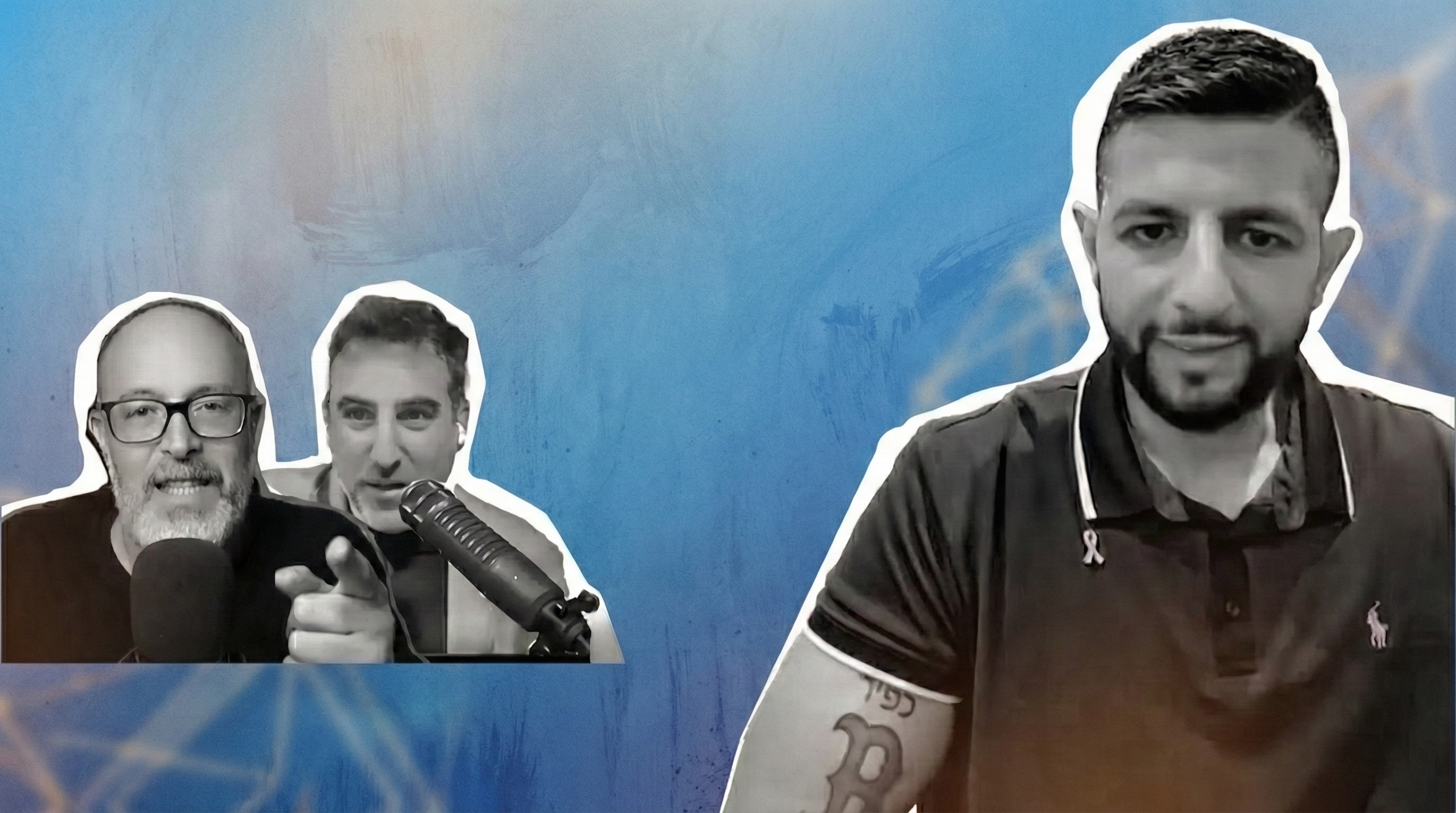
Lio: We're live here on TheJewFunction. I'm Lio. This is Seth. Morning, everyone. With us today is Michael Gamal. Is it Gamal or Jamal?
Michael: Gamal. So my middle name is Jamal everywhere else in the Arab world, but it's Gamal in Egypt, where my parents are from.
Lio: Okay. Very good.
Michael: It's also my dad's first name.
Lio: Yeah. Gotcha. Okay. Gamal it is. And he is a very interesting person, which you'll get to know him if you haven't met him on Instagram, where he's very, very active. He's got a very interesting story. You were born into a Coptic Christian family, right?
Michael: Correct.
Lio: In the U.S. And then you grew up, you had the typical American upbringing that made you a pro-Palestinian activist. And then I think something changed, which you'll tell us what. And I think since October—I saw 24th, October of last year, I mean, I'm sorry, two years ago—you've been running a very, very active Instagram channel talking pro-Israel, about the Jewish people. You're having conversations with Muslims from all over the world and all kinds of people. And really like a 180 shift. And we would love to kind of hear a little bit of your story. You're the, I think, second Egyptian here on the show. The last one was actually, he also had a similar change of heart, but he was in Egypt. You are living in the West. That's probably a different story. So maybe tell us a little bit about where this started. I mean, start wherever you want. If you want to start with early childhood, then go through your athletic career. No, just get us into your mindset as a young man growing up on the West Coast, where you are, and then kind of what happened.
Michael: One correction—I've actually only had the Coptic Capara Instagram channel since I think like April of 2025, so it's very, very recent. So I'll start from the beginning. I was born in Milford, Massachusetts. I grew up in Massachusetts until I was 17 and then I moved to California with my family. I was still, you know, I was basically wrapping up high school. I finished off my senior year in California. And growing up in Massachusetts, I was very, very naive. I didn't have any Arab or Muslim friends. I didn't have any Middle Eastern friends. I thought I was like the only Middle Eastern person in the state. I went to a small Catholic high school, less than 500 students in the entire student body. And I had a relatively typical upbringing until 9/11.
You know, it's funny because growing up, you get told things like "go back to Egypt" and stuff like that. But I never interpreted that as being racism. I just absorbed it as typical teasing, bullying stuff. Anybody went through, you know, I had Puerto Rican classmates that were told the same thing. So I didn't interpret it as being a race thing. I mean, up until 9/11, I thought I was white. So that's what's funny about it—after 9/11, that was the first time in my life I started being told I was Arab, which, ethnically I'm not Arab, I'm Coptic. But 9/11 changed things for me because...
Lio: Just tell viewers the difference between, just so they know.
Michael: So Coptic—most Egyptians are ethnically Coptic. Even though Egypt is known as the Arab Republic of Egypt, most Egyptians are ethnically Coptic. The Arabic identity, the Arab identity didn't really take hold of Egypt until Gamal Abdel Nasser. Maybe you can make the argument for King Farouk because he was a participant in the 1948 war. But yeah, so Egyptians have this sort of identity crisis where they believe they're Arab. Egyptian Muslims tend to believe they're Arab far more than Coptic Egyptians.
So Coptic Egyptians—the word Coptic is a fancy word for Egyptian—and typically when you refer to a Coptic person you're referring to somebody who was born into the Coptic Orthodox Church. The vernacular of today sort of denotes that a Coptic person is a Christian.
In any case, I grew up kind of detached from my Coptic identity because it was just a religion to me. I lived about an hour and 10 minutes away from the nearest Coptic Orthodox Church. So I was going to Catholic school Monday through Friday, and then I was waking up at 6 a.m. on a Sunday to make it to Coptic Orthodox Church on Sunday.
And in any case, when I moved to California and I was finishing high school, entering college, that was the time where I started to meet Arabs and Muslims for the first time. And I would meet Palestinians, Syrians, Egyptians, Lebanese. And then that was when I was introduced to the Palestinian narrative.
Now I had heard about it before, but I didn't have really anybody who had that background to talk to about it. The earliest that I had heard about it—and this is how naive I was growing up—I didn't even know that Egypt was part of this broader Arab world until after 9/11 when I was like, you know, I was 14 when 9/11 happened, I think. And then like 16, you start to develop this political consciousness. I remember reading the autobiography of Malcolm X, which had a profound impact on me.
And yeah, I remember the earliest I heard about what the Palestinian narrative was from my cousin who had come back to visit from college. And he said, you know, he was talking about it a little bit, but I didn't pay much attention to it. And then once I started college, that's when I started meeting my friends, and they sort of told me about everything.
And it was a unique time for me because that was the first time in my life where I had met people who, first off, spoke the same language as me—different dialect, but same language—listened to the same music my parents listened to when I was growing up, watched the same movies, had a very similar immigrant experience to the one I had. So for the first time in my life, I felt like I actually had a collective that I fit in. Whereas before that, I always—it's not that I stood out, but it was obvious that there was something about me that was different from my friends.
My friends growing up were Polish American, Italian American, Irish American. Their parents spoke English, their parents didn't speak another language. Meanwhile, had my friends come over my place, they would hear Arabic in the background from my parents.
And so it was different. And when I was being taught the Palestinian narrative, I didn't have anything to counterbalance it. And my parents were never ever—this is something I always like to stress—my parents were never the source of indoctrination for me. My parents were actually very much against the Palestinian cause because they saw it as an extension of Islam. My parents look at anything, if it's majority Muslims participating in it, they interpret it as being a Muslim cause. And my parents, given their background and like the background of our people in Egypt, they're very much against furthering the cause of Islam.
Seth: Did they have a negative experience in Egypt with that?
Michael: My dad not so much because my dad left in the late 70s. He left in 1977. My mom had a couple of experiences that weren't great. But it wasn't with the Palestinian cause in general, it was just with Muslims. Like she had experienced some discrimination from professors in school.
When my parents got married here in the States—they met here in the States, in Massachusetts—and then when they, because once you get married here, if you want to go visit Egypt and be able to live as a couple in Egypt, even if you're just visiting, you have to get your marriage certificate transferred over. So you have to go to the embassy or the consulate. And when my mom went to the consulate, she said that one of the people working there said that they couldn't touch the marriage certificate because it was dirty. In Arabic it's called nejas—it's unclean for that person to handle.
And she was shocked that this would happen at the embassy because she was under the impression that, yeah, there's discrimination, but people who work for the government and work at the embassy—these are the people who should be the most professional people on earth. And I mean, after that too, the other embassy staff, you know, the other guy was very, very apologetic and apologized profusely for what had occurred. But it stood out to her that things are changing.
And this was sort of a consequence of Anwar Sadat's Islamization of Egypt. I'm not like here bashing Anwar Sadat because I'm very thankful for the peace treaty that he signed with Israel. But an honest look at Anwar Sadat's record with Egypt will show that he was the primary cause of Egypt's Islamization. He made Islam the state religion. He put in the constitution that the source of Egyptian law and legislature is the Quran and Sunnah. So that's when things started getting really bad for the Coptic Egyptians.
He also had a pretty big fallout with the Coptic Pope, Pope Shenouda. He exiled him to a monastery in the desert. And I will say, actually, that on some level, Sadat—the fallout between him and Pope Shenouda was more than just about one thing. Pope Shenouda took it up with Sadat that there was growing Islamization and he was worried about the Coptic experience. But then also Shenouda sort of stuck his nose in the Arab-Israeli peace process and said that it wasn't right for Sadat to sign a standalone peace treaty with the Israelis, that it should have been part of a broader Arab peace. On this aspect, I actually think Sadat was right. I don't agree with Pope Shenouda.
Lio: But that was the time when the whole pan-Arabic dream was alive. So that's probably why. But maybe I think the question is, what got you involved with that cause?
Michael: Yeah, my friends. When you go through most of your life feeling you didn't belong anywhere, that you didn't have really like a tribe to be part of, and you finally find one, you are sort of willing to do whatever to keep your place there. And it was never said explicitly to me that you must support X, Y, and Z, you must believe X, Y, and Z to be part of us. But it was, you know, it was by default, essentially. It was less than implied, but it was sort of understood.
Lio: So you just find yourself, like, walking into a BDS protest?
Michael: No, that's the thing—BDS and stuff like that, that's for the non-Arabs and non-Muslims to take part of. The higher levels of that stuff will always be Arabs and Muslims. But BDS, Students for Justice in Palestine, all that stuff—that's for Westerners to basically be indoctrinated. I went to two Students for Justice in Palestine meetings and it was all white people.
Seth: Michael, was there—for example, if you get into Manchester United, you know, you get into some football club or something like that, so there's a story of Old Trafford, you know, there's a story of the stadium and there's the story of their glory days and David Beckham and Ronaldo—and like there's a whole storyline, there's also just like an aura about something. When your friends were talking about this, is it more just like hooligan style, just the aura of it? Or when you got into this world, was there a whole mythology and a whole story behind the whole thing that everybody was getting behind? Was there somebody—there's a narrative and everybody's getting their line? There's a pipeline and the whole thing?
Michael: There's certainly a narrative and then there's sort of the aura of just being a young man in America. You know how young men are in their early 20s, going out and stuff. But it was a combination of both—it was a combination of finding this collective in your early 20s and this narrative that feels so natural to you.
And the thing about the Palestinian cause is when you're being indoctrinated in it—and I can safely say that I sort of indoctrinated myself into it—you feel, because you embrace this Arab identity, you speak Arabic, you feel in a way like this happened to you. You look at your friends—I looked at my Palestinian friends like my brothers, and their experience was almost like, their experience was my experience. Their pain was my pain. So it is sort of this solidarity around misery and suffering, which is the currency of Palestinianism—misery and suffering.
Seth: Were there—you mentioned Malcolm X's autobiography before—were there certain books, were there certain speakers, were there certain leaders within the movement? You also mentioned your cousin who was at university when he came home from university. I'm not specifically alluding to like Qatari influence for example, but I'm saying, was there some concerted efforts somehow to push this thing?
Lio: He's asking, is there a guiding hand? I mean, because we know now all the influence that has penetrated the U.S. and it has penetrated for the last two, three decades, right? But did you feel that? Did you see it? Or is it more just a natural, these are my people?
Seth: Yeah, young men like joining a gang kind of, need something to identify with?
Michael: You had speakers and stuff like that. You definitely had books. But for me it was more of a natural "this is my people" type stuff. It wasn't what it is today—like back then in 2009, 2010, it wasn't the industry it is today.
You also have to take into consideration that this is sort of the earlier days of social media. It wasn't as prominent as it is in today's society. Obviously people like Norman Finkelstein were as busy back then as they are today. There were books but you had to really go out and look for those books.
I remember I went to an Islamic bookstore called Al-Jaber Bookstore in Orange County and I picked up this documentary—I can't remember the title of the documentary but it was something Palestine—and I remember it showed the very typical infographic where it was like the map of Palestine with the Palestinian flag and it's like, "oh this is what Palestine looked like in 1948," and then it showed 1967, and so on and so forth.
So it was sort of like you were guided by your people and then you did a lot of it yourself. I can safely say out of all my friends I was actually probably the most interested in educating myself on it and trying to be the best activist that I could.
This is going to sound kind of stupid, but I remember we participated in substance abuse, we smoked weed and stuff like that. And while I would be high, I would be on Wikipedia, just going down a rabbit hole, just trying to learn.
Seth: Well, we all did that. We've all been there, brother.
Michael: But all my friends would call me a nerd. All my Arab Muslim friends would call me a nerd for that. But for them, they had lived this their entire lives. They had grown up around each other their entire lives because they were mostly Muslim, so they went to the same mosques. Me, this was still new for me, so I had to really educate myself on this stuff.
Seth: So you are a real researcher. We are too. That really gets us to the root of it. What was the best—like what was the gem of truth at the essence of it? Or what was the gem, the redeeming, something redeeming inside of it for you that you saw there? You talked about belonging, but in the movement itself for people. And if it was just belonging for young men, so okay. But maybe there's something more ideological. And then what is the point where it feels like there was some cognitive dissonance here? Like something about this, when does that happen? Something about this is not...
Lio: Well, I think we all guessed it's October 7th, but we'll get to that in a second. Let's finish first just dissecting just the thing itself, that internal movement that Michael is describing, because I think it's important. I think it's probably mirroring a lot of similar sentiments in young people today. So I want people to really hear it. So let's focus on that period before we move further.
Seth: The spark of truth, the redeeming quality inside of that whole thing for the young men. We see young men joining gangs, we see young men joining all kinds of things for belonging. So that's not unique to what we're talking about here. But there is a social—there's something in all these things, there's some spark of truth somewhere in there. I'm interested in what that was.
Michael: I mean, the truth was the suffering. You can't deny that they suffered. But it's also why do they suffer—that part was never really addressed or looked at honestly.
And for me, sort of like the moments of dissonance were just the reality of what had actually happened. So you can't learn about the conflict without learning about the fact that it was five Arab countries that started the war. You can't learn about the conflict without learning that it was the Arabs that rejected the partition plan. You can't understand the conflict without all these little facts.
And from early on, I noticed there was this pattern of we would start wars, we would lose them, and we would suffer the consequences. So you always have to sort of bend and circumnavigate the truth to make yourself out to be the victim.
And so it's very common—I mean, you hear it today. If you ever get into a conversation with somebody who's pro-Palestinian, no matter what you say to them, they will always respond with, "well, that doesn't justify, that doesn't give Israel the right to do this," da-da-da-da-da, right?
And so at the crux of it, it is maintaining the narrative of Palestinian victimhood. That is the core of their story—that they are eternal victims and the Israelis, the Zionists, are eternal oppressors. So the Palestinians have every right to use force and the Jews have zero right to defend themselves. And that is just as true today as it was when I was learning about the conflict when I was 18, 19, 20.
And yeah, I'd say the redeeming thing about it is just again being with a group of people whom you identify with. That became my entire social circle. After I met them, I didn't really have friends that weren't Arab or Muslim. Everything that I went to was an Arab event. You would go to these dinners at an Arab restaurant and it would be themed—like if you went to a Syrian night at an Arab restaurant, you would have somebody there talk about how the Golan Heights is Syrian and will forever be Syrian. So it was really all-encompassing. It became every facet of my life.
And it's funny because I met up with my dad yesterday, and him and I were talking about it, and he just told me, "I don't think you understand just how much it took over your life. Like, you wouldn't shut up about it. You wouldn't stop talking about it. It dictated everything in your life."
Lio: Well, first of all, obviously, you have a strong will and lots of curiosity, which I think helped you get through all of this to where you are maybe today. And maybe other things as well, which we'll touch on in a little bit. I just want one last piece to this because I am curious.
Here in Israel, they find a lot of—I mean, not just right now, but if you kind of scan the history, you see a very close connection between the Muslim Brotherhood and then the Palestinian cause and Nazi Germany, right? They were in bed from day one, pretty much. And you find them until today. You find people walking around with Mein Kampf booklets in their vests and all that. Were there components like that in the circles you were hanging out in?
Michael: No. If anything, they tried to make the Zionists look like collaborators with the Nazis. Or they would go with the line that, "oh, the Palestinians shouldn't have to suffer for what the Nazis did to the Jews." That's sort of like the logic behind it.
But later on it certainly became a component. It absolutely did. One of the things that ended up happening over time was that the group that I was part of sort of split off. And that was because of the Arab Spring. I was supportive of the Egyptian revolution, Tunisian revolution. But when it came to Syria, that's when things got different.
Because I was always a secularist—I was very secular—and I saw Bashar al-Assad as a secular leader in the Arab world, and a secular leader for me was always going to be better than an Islamist leader because at least the secular leader would be protecting religious minorities in the country.
And so me, as a Coptic person, I would think first and foremost of Christians in Syria. And a lot of people have this misconception that Arab Christians are natural allies of Israel, which is not the case, particularly amongst Syrian and Palestinian Christians. They're very, very much opposed to Israel. They are just as hateful of Israel as their Muslim counterparts.
And so anyway, I went the route of supporting Bashar al-Assad, and so did some of my other friends. But that put us at odds with the rest of our friend group who were more interested in seeing a Muslim leader.
And then from there it became very complicated to say the least. You still had friends of course, but the friendship wasn't the same after that. That's when you saw a lot of the sectarianism. I remember my friend Samir, he was going off on a post I'd made about Bashar al-Assad and he's like, "No, Mike, you don't understand. In Syria all the best jobs go to the Alawis. There's discrimination against Sunnis. All the top officers in the military—they're all Alawi."
And it was very much sectarian. I didn't realize this then, but Samir and his cousin Bashar, their family was part of the Muslim Brotherhood. They were from the Muslim Brotherhood in Syria. They had actually left in the 80s because the president of the time, Hafez al-Assad, cracked down on them in Hama. So they actually fled Syria because they were being cracked down on.
And there were other moments of dissonance—I mean, not just dissonance but like moral bankruptcy. So I remember in 2013 or 2014, the Fogel family was murdered in their home in Itamar in the West Bank. And I remember it was like the first time I was really shocked by the level of brutality of the Palestinians. And it was the first time I'd actually condemned Palestinian violence.
And I made a Facebook post about it. And my friends really tore into me, called me a Zionist propagandist. "You're parroting Zionist talking points" and all this. And they said it was obviously the Zionists who did this to make the Palestinians look bad.
I remember we had one friend—can't remember his name, but he was the brother of my friend Osama. He had gone to UC Berkeley, and he was very much like the prototype of what you would see today from college activists. Very, very involved in BDS, involved with all these groups. If Mamdani was running for New York mayor 10, 12 years ago, I know that he would have probably been campaigning hard for him on college campus. But yeah, that's the best way I could describe it.
Lio: And so you're starting to see some cracks in the friendship, cracks in the story. But you still are starting to question yourself, doubt yourself. Is this when you're starting to maybe expand what you're reading? Or did it take October 7th to kind of push you over the edge?
Michael: So this is the thing. October 7th isn't what did it for me.
Lio: Okay, so what did it?
Michael: I woke up on October 7th, and that was a victory for us. I hate saying that. It pains me to say that. I wish I could sit before you today and tell you that October 7th was what woke me up. But I actually dug my heels in more because I felt like, "oh, now is the time to rise to the occasion to defend my people."
And what ended up happening was shortly after October 7th, my dad called me. He asked to have lunch with me and I went to go see him. My dad and I were always like this politically—would never see eye to eye. I mean, he despised what I believed in. I despised what he believed in. So we were very much at odds politically.
And then anyway, I met him up for lunch and he just really leveled with me. He told me first off, "Your mom has told me about the things you've been posting online"—my parents split up about 12 years ago, so that's how they communicate, through the phone—but he told me that my mom told him about the things that I've been posting online about Palestine, Israel, and stuff like that. And he said that he's really worried about me.
He basically told me that what Hamas did to Israelis is exactly what ISIS did to people in Iraq and Syria. They murdered, kidnapped, raped, burned people alive, mutilated their bodies. And I had to recognize how hard it was for him to come to me with that, because like I said, we were always at odds with each other. So he sort of went out on a limb to try to connect with me on this. And it had an effect on me—to what extent, it probably wasn't as great of an effect as he would have wanted.
Seth: You didn't know or something else about it that there was...
Michael: I mean, I had heard that horrible things happened. When I woke up on October 7th, I just thought a bunch of people were killed, right? And I struggled to believe that it was as bad as it was just because normally anytime an attack happened, it didn't get that far. It wasn't on the level of October 7th.
So when you heard about the rapes, the first thing you want to do is deny them. Because you can justify killing people, but sexual violence is on another level. Sexual violence—for some reason it hurts people so much and people have such a natural disgust with it, as opposed to somebody killing somebody else, because it is primarily about abuse. It's about degrading and hurting somebody in the worst way possible.
So the first thing that you do is you deny that the rapes happened. And so when my dad told me about that, it had this effect of like, "shit, this is really, really bad."
And then a week later I was in San Diego. I was there with my then-girlfriend and our friends and we were bar hopping, going from bar to bar. And we were at a red light, waiting for the light to turn green so we can cross the street. And in front of me there's sort of like this structure—maybe like an electrical utility box or something—and it has the posters of the hostages on it.
And I remember I'm looking at the posters of the hostages, and all I can think about was how I had seen footage of people, whether it was in Toronto or New York City, defacing the posters of the hostages. And it felt like the blood in my veins evaporated.
I remember looking at these posters of these hostages and saying to myself, "You might be a piece of crap for the stuff that you support, but you're not such a piece of crap that you would ever deface the posters of a hostage."
And that was the closest thing I've ever had to an out-of-body experience. Really, it felt like the blood in my veins evaporated. It felt like that moment lasted an eternity. It might have lasted like 15, 20 seconds. And then that moment was over and I went on with my drinking for the night.
And then a few months later—or maybe a month later, I'm not entirely sure—I noticed people who I always hated, like despised, started supporting the Palestinian cause, like Andrew Tate and Candace Owens.
And then I would say that the final straw that pushed me out was Israel had struck an Iranian facility in Syria, I believe in March. It was sort of adjacent to the Iranian embassy, it was being used as sort of an IRGC base to stage attacks. And the following month in April, Iran launched its first missile and drone attack against Israel.
And I remember the reaction from my friends and the rest of the people who were sort of involved in the movement. What stood out was—because countries like Jordan and Saudi Arabia were helping in taking down the missiles and the drones—the reaction was, "oh, King Abdullah and bin Salman, they're kuffar, they're infidels, they're Zionists, they're owned by the Jews," and all this.
And in my head, I was thinking, if those countries didn't, if those countries allowed their airspace to be used by Iran to attack Israel, Israel would have every justification to then attack those countries, particularly Jordan, because Jordan actually has a formal peace treaty with Israel. And in these peace treaties, you can't allow your airspace to be used by a hostile nation to attack the nation that you have peace with. Otherwise, you're in violation of that peace treaty, and then your country becomes a legitimate target.
And I remember saying to myself, "These people just really want to watch the world burn."
By the way, the only person that died in that missile and drone attack was a Bedouin girl. A little Bedouin girl, like six years old. She was killed in that attack.
And so I remember the following month, I was so thoroughly disgusted. I took down everything in my profile, my personal Instagram page. I took down "Free Palestine" from my bio, took down every post I had made for Palestinians. I was done.
I just wanted to silently walk out of this. And I was going to be this sort of both-sides person who didn't even pay attention. My intention was that I wouldn't care about this anymore. I'm done with it. I don't want to be part of this anymore, and I just want to live like a normal life where I don't pay attention to this realm of politics.
Lio: Like a normal indifferent person?
Michael: Yeah. To be honest, to this day I'm sort of jealous of people who find themselves indifferent to this, because for one reason or another this means a lot to me.
But the following month, Noa Argamani was rescued in June. And I remember I was at the gym, I picked up my phone, I looked at notifications, it said Noa Argamani was rescued. And I was really happy. I was really happy because the way I interpret it was, "okay, the more hostages get rescued, the quicker this war is over," and the better odds we have at attaining some sort of normalcy.
And as happy as I was—and that was probably the first time I was ever happy for an Israeli, I was happy that Israelis recovered their people—as happy as I was, about 30 seconds later I was beyond upset.
Because even though I had silently walked out, my social circle was still the same. It's not like I lost friends or anything doing what I did. My social circle was still entirely the same. So I'm still looking at the same propaganda, the same content on Instagram.
And so I saw this post from a Palestinian comedian, Sami Obeid. And what he said was, "If I'm ever held hostage somewhere and you have to kill however many people to rescue me, just leave me there as a hostage."
And I remember thinking that this was the most insincere, disingenuous thing I'd ever seen in my life. There's no way you can possibly feel like that. I have three dogs. If any one of my dogs was kidnapped, I would burn down the world to get my dogs back. So I can't imagine what it's like to have a brother, a sister, your mom, a human that you love, kidnapped by terrorists and held in the most abysmal conditions.
And today, now today, you realize just how bad these conditions were. I went a few weeks ago to see Eli Sharabi at Temple Sinai in Los Angeles. I actually got to shake his hand and meet him. And he was talking about his experience. These people were being held in the most vile, miserable conditions. So I would burn down the world to get back my loved ones. And so I don't fault Israel at all for doing whatever it had to do to get back their hostages.
But that was sort of like a black and white issue, right? She was rescued. Some people had to die in the process, and that was it.
And the next month, I can say that what happened the following month is really what propelled me to Israel advocacy. The following month was when the Majdal Shams missile attack happened, and Hezbollah killed a bunch of Druze children at a soccer field.
And I remember, almost like how sports do a play-by-play analysis of a game, I had followed it from the minute it happened. So I knew exactly how Hezbollah initially reacted. Hezbollah initially took credit for the attack because they thought they hit an IDF headquarters not too far away, like in Mount Hermon. So they took credit for it through their news affiliate, Al Mayadeen News.
And then once they realized that they killed a bunch of children, then they started saying, "Oh, well, it was actually an Israeli Iron Dome missile—a misfired Israeli Iron Dome missile that struck the soccer field."
And so I was like, "This isn't adding up." So I did my research and I started comparing the missiles that Hezbollah uses versus the missiles that are used by the Iron Dome.
The Tamir missile in the Iron Dome—it's much lighter. It has regular shrapnel. It's not meant to maim or kill people. It goes in a completely different trajectory. Meanwhile, the Hezbollah missiles—they contain irregular shrapnel. They're a lot heavier. Their purpose is to maim and kill.
And so then I looked up instances of where a misfired Iron Dome missile could have hurt somebody. And the worst case scenario that I found was that it landed somewhere nearby a construction site and it caused moderate injuries to a full-grown man. Didn't kill him. So we know that the Tamir missile in the Iron Dome—there's no way it could kill 12 kids. There's just no way.
And so I remember I went on every sort of pro-Palestinian page and was leaving this information in the comments, right? And of course I got shouted down, called a propagandist, and all this. And I got blocked from every single one of those pages. They didn't like the facts.
But that was—I didn't realize it back then—but that was what ended up propelling me to Israeli advocacy. I wasn't showing my face. I was just leaving comments, because like I said, most of my friends were still in the same social circle. But it just became something that I did every day.
And by this time I'd also started going on the app Ome.TV—that Omegle-type app where they do the video chats—and I'd actually made Israeli and Jewish friends for the first time in my life.
And the thing about that Majdal Shams rocket attack was one of the friends that I had made—she was Israeli. She knew somebody who lived in Majdal Shams, so it really hit her personally. And it was the first time for me that I could watch—I saw an Israeli person that I knew suffer. I witnessed their grief on a personal level.
And it's one of those times where you say to yourself, all this time I supported a bloodthirsty cause and didn't care about the victims of that bloodthirsty cause. And this is what that looks like—to see her experience this grief.
And by the way, remember how I mentioned Andrew Tate earlier? So part of the reason why Andrew Tate's support for Palestine bothered me so much was my friends really embraced Andrew Tate when he converted to Islam. They liked him previously to that. They previously liked him. I thought he was a disgusting human being—sex trafficker, all this stuff. But they really embraced him after he converted to Islam.
And I remember saying to myself, "They care more about a Muslim sex trafficker than they care about his non-Muslim victims."
And that was important because I realized, as it relates to Israel-Palestine, that I wasn't much better. I cared more about a bloodthirsty cause than I cared about the victims of that bloodthirsty cause. And so where I would look at Andrew Tate and Candace Owens as grifters, I had this realization like, "Oh, that's not too far off of what I'm doing. I'm really no better than them."
So there is this personal disgust I had with myself.
Seth: Maybe that gets to the point, Michael. There's a balance here and an important inflection point here that on the one hand, now you say the facts are adding up for you, right? This story is coming into focus somehow on the one hand, and it has a certain gravity. On the other side—like, why the hell put yourself through that? Did you feel that you're going to make a whole new group of friends and associates? Or, I mean, it seems from where you're coming from that it means you're basically going to isolate yourself from your entire social circle—and not only that, maybe even be in danger or have to look over your shoulder. On the other hand, so that's a lot of weight on the other side.
So why? What is it that changes the balance there? Because that's not—even if you do find these facts and the other side of the scale starts to weigh heavier, you can keep it to yourself. You don't have to go out into public with it.
Michael: Yeah, I didn't think about those things when it was happening. I didn't have any expectation to be doing what I'm doing today. I say that all the time. I had zero expectations. If you told me back in July of 2024 that I would be doing this today, I would have told you you're insane.
You have to take into consideration that by 2024, the people that I knew in my social circle, the people who were closest to me—I'd known them for nearly 20 years. I mean, these are people I sort of took it for granted that these people would be at my wedding. When I had kids, that my kids would play with their kids. Things like that. And so I never ever really imagined a day where they wouldn't be in my life.
But the more I started advocating for Israel, the more I started educating myself, the more and more I started to withdraw myself from them, the more they felt distant to me. And by the time I had gone public, they felt like strangers to me, including the people who were closest to me.
And I just kept going with it. Because once you start to find out the truth—and I remember there was this instance, it was sort of like a light bulb moment. There's this YouTube channel called Traveling Israel with Oran—not Tal Oran, the traveling clot, but Traveling Israel. He said something that I'd never taken into consideration before.
Before the Arabs launched a genocidal war of choice, before they rejected the partition plan, not a single Arab had been kicked out of their homes. Not a single Arab had to flee their homes. Not a single Arab was expelled. So literally the entire conflict, all their suffering, is their making.
And then I remember, this is probably in the same month of July, I was just sort of running errands around the house, and so I put something on YouTube to listen to in the background. And it was Dr. Einat Wilf speaking with Yasmine Mohammed.
And prior to, up until this point, you heard about UNRWA, but you didn't really pay attention to it. Honestly, anytime I heard about Jews or Israelis complaining about UNRWA, I always dismissed it like, "Oh, they're just complaining about everything. They just want to frame everything as terrorism."
But then when I heard Dr. Einat Wilf speak about it, I was like, "Oh, this is real. This is actually a horrible, horrible organization." And that got me interested in learning more about UNRWA.
Her book, The War of Return, is incredible, really incredible. And the Traveling Israel show on YouTube, he also recommended a book called The Industry of Lies by Ben-Dror Yemini, which I also read—also an amazing book, criminally underrated.
And so by the beginning of 2025, I had actually developed an interest in Judaism. I wanted to learn more about Judaism. I realized I was doing advocacy and defending Jewish people, but I didn't really know anything about the religion, right?
My parents—the way Judaism was explained to me throughout my entire life was like a movie. Judaism came first and Christianity was a sequel. That was literally what my parents told me—"Oh, they're the first half of our religion." That's how Judaism was explained to me. So I didn't really understand Judaism that much.
And I started going to temple. I still go to temple. I was just there on Friday. I went there for Hanukkah, Pesach, Purim. And I went there for the first Shabbat after Yom Kippur, which I didn't know was actually the most important Shabbat of the year.
But I remember attending these services, and there was one day where I walked out of Shabbat services, and I turned my phone on, and I get a message from my closest friend. And I open the message, and he sends me a YouTube link, okay? And I remember it has a picture of Hitler on it.
And I didn't click the link, but I remember what he had written in his message was, "Maybe he knew something that we didn't."
The video said something—Hitler or Palestine—I can't remember because I never watched the video. But it's what my friend said, where he said, "Maybe he knew something we didn't."
And I remember it was that moment where I was like, "I can't fucking do this anymore. I cannot keep doing this with them."
And I blocked everybody—literally blocked all my closest friends, cut them off right then and there. And on my way back home, I'm telling myself, these people that I'm attending Shabbat services with, they're so sweet and kind to me. They've been so lovely to me. I can't fathom—why on earth did I hate them? Why? They're so sweet.
And so when I got back home, I decided that I would do this video confession. And it was like 20 minutes long. I talked for 20 minutes on this video confession.
And it was important because I cut off my closest friends, but then I had this other circle of friends that I thought—they've sort of seen me change a little bit. They noticed. I remember I had a couple of friends bring up to me, "Hey, I've sort of noticed you've been leaving these types of comments on pages."
And I was like, they saw something change in me. So I thought if they had stuck with me till then, that maybe they'll understand my reasoning for why I'm coming to this conclusion and believe in what I believe.
And it was also important for my Israeli and Jewish friends that I had made up until that point, because I didn't tell them about what I was involved in prior. I was so ashamed of myself. I thought it was the equivalent of being a murderer. I was so disgusted with myself. It was something I took great shame in. And to this day, there is a shame component in it.
So it was important for them to know the truth about me and just to set the record straight for the people who are still in my life.
And I lost 99% of my friends from that video.
But the Jewish and Israeli friends, when they heard everything, they're like, "Oh, yeah, of course you did." They're like, "Yeah, sure, yeah." They weren't surprised. They were like, "Yeah, you grew up with Arabs and Muslims. Of course that's how you felt."
I was dumbfounded by how okay they were with it. To this day, I'm surprised—I didn't lose a single friend. And to this day, some of those people are still my friends and my biggest supporters.
Lio: I want to ask you something, Michael, because I think this is a crucial point. I think, you know, you hear a lot of people talk about, "Oh, you know, change your mind—it shows you have one," and all those kind of nice affirmations.
But nobody really talks about this feeling of jumping off a cliff. Because you're leaving behind all your entire social life, your entire identity, who you are, who you were to yourself, to other people. It's not simply changing an opinion. Sometimes it's years.
A lot of it sounds like a spiritual awakening, I would say. When you suddenly realize, "Oh my God, everybody's just running around chasing all these material things," and suddenly you have higher interests. "How will I hang out with those people? What will I do if we're going to talk about the stock market? I don't care about the stock market anymore. I don't care about those things."
I think that's the key point. Maybe you can say a little—first of all, I mean, it sounds from your story like you were almost kind of pushed into this. But still, you had to make certain choices along the way and you had to get some strength. Where did you get your strength from? Where did that come from? Is it because you're a bodybuilder? No, I'm just kidding.
Michael: I'm somebody who will stand by what I believe no matter what. I'm willing to lose friends over that. I lost friends when I started being pro-Palestinian to begin with, because up until that point I was still going back to Boston to visit my friends in Massachusetts. But once I started getting really involved with the pro-Palestinian stuff, I isolated myself from them. I stopped talking to them. They couldn't understand where I was coming from, and to me, I looked at them as like, "You just—you'll never understand."
And so I willingly lost friends over the Palestinian stuff too. And so I've never been afraid to lose people in my life. Maybe that's not such a great thing about me. It's pretty easy for me to detach from people. But it's also been sort of what protects me, in a way—that I will stand by what I believe if I think it's right.
And so, I mean, yeah, it was tough. I'm not going to say it was easy to do that with my friends that I'd known for nearly 20 years. But at the end of the day, you have to live by what you believe is right. And my friends, unfortunately, they had really grotesque beliefs.
Another aspect of this that I don't know if you know about is that around the age of 32 or 33—this is 2020, 2021—I had converted to Islam.
Lio: I mean, I read that you did. I didn't know exactly when it came in.
Michael: And that was an ideological decision. I didn't convert to Islam for spiritual reasons. I converted to Islam because I felt like Islam validated my hatred of Israel and the Jews. Even when I took my Shahada, I had a t-shirt that had the outline of Palestine on it with Al-Aqsa Mosque right on Jerusalem. So it was very much an ideological decision of mine.
And being Muslim, being really on the inside with your Muslim friends, there's a new reality to that. There's so many layers to this. And there's a lot that's said about Islam, and a lot of it is true. It glorifies violence.
Listen, there's violence in the Bible, and there's violence in the Quran. So a lot of people will make this false equivalency—"Well, aren't both religions violent?" And the answer to that is no, because the violence that's in the Bible is narrative violence. It is recalling violence that happened during certain events.
Now, there's obviously violent commandments—like, "If a man lies with man as he lies with woman, it's an abomination. Their blood shall be shed upon them." Leviticus, all that stuff. I'm not saying the...
Lio: By the way, just for the listeners—there's not commandments. There's the Ten Commandments, and then there's the additional law that was given. And we can talk about the interpretation of that.
But I will say, before you continue, just for the sake of people listening, it's important—if you've never visited Israel, for example, and actually went into some of the... Because I think Israel is one of those places where you can actually see the two sides. It's more difficult to go into Syria or Afghanistan or whatever, but you can come and you can visit the two sides relatively simply, easily.
And you can see that one is educating people for love of others, for peace, for all those things. And the other is really indoctrinating their kids to hate and to glorify death and all that. And it's hard for people to imagine that people could actually do it. And I think it's hard for them to kind of accept it, to believe it.
And maybe that's one of the things that make people want to see this conflict as like, "Oh, it's an equal. It's just people trying to live together." And it's like, no, no, no. It's two worldviews that are really at odds here.
Michael: Yeah. I mean, the Arab and Muslim world wants so desperately to believe that Israel is just as bad as its neighbors. They try to create this image that Israel is no different than Syria, Israel is no different than Iraq, it's the same type of government—which literally couldn't be further from the truth. You don't even have to visit Israel to understand that. That's the thing. You can watch stuff on YouTube. If you watch the Corey Gil-Shuster channel, you could...
Lio: You know what, Michael? We say that if you like someone, then it's easy to find reasons to love them. But if you dislike someone, it's easy to find reasons to hate them. And I think that's kind of where the split is.
The question is really—I think, I mean, first of all, there's so many questions. I hope you have a little bit more time because this is definitely not like an hour talk. This is much longer. If we can get a little over here.
But I think the question is, as you were going through this process and where you are now, even in this—do you feel like it's, "Oh, I've had a change of heart. I'm now"—I'm simplifying it deliberately, right—"I'm not working for this side, you know, there's a big conflict and I'm now going to support this instead of that, and that's the end of it."
Or do you feel this is part of a greater mission or a greater shift in the world? I'm curious to know how you see it. And if you've even investigated the Jewish people enough to even consider the anomaly about their situation in the world to begin with, a priori. So give us some thoughts on that.
Michael: It doesn't feel like a switch sides. I mean, I understand to somebody who watches this, that's the way they'll probably interpret it. But the way I see it is I realigned with my values.
So I'm pro-LGBT. I have a gay cousin, right, whom I love dearly. You sort of think, well, which country in the Middle East is the only country that would give him the dignity of life that he enjoys in the West? That would be Israel.
Me, I'm very outspoken. What country would give me the right to have my own opinion? What country would give me the right to criticize my leadership? I couldn't do that in Egypt. I'd get locked up immediately.
And I do feel that it is part of a greater mission for me. I was actually just talking about this yesterday because I was talking about spirituality—where I find myself spiritually. I don't talk about it a whole lot because my spirituality, it's not something I want to make a spectacle out of. But I do follow the Noahide commandments, the seven Noahide commandments. Try to follow it to the best of my ability. I'm not going to say I'm a saint in that regard.
And this is tough for people to sort of reconcile. People are going to have different opinions about this. But I do feel that anti-Semitism is very, very unique in how it has—like, the Jewish people have endured throughout history. They've defeated all their enemies. But anti-Semitism has also endured throughout history. There is the same Jew hate today that there was in medieval Europe.
And to me, that is not a coincidence. I do think there is a supernatural evil and there's a supernatural good. I do feel that we are in the middle of a fight between good and evil. And I don't know how much religion plays a role in this, but I do feel that God is protecting the Jewish people. And I feel like this is just—it's not a coincidence.
I'm not trying to preach, so don't interpret this as me trying to preach my spiritual worldview to you guys. I'm just explaining how I feel about these things. And I feel like to go against Israel, in essence, is to go against what God wants.
I feel like I was on the side of evil for so long. And finally, I think—things didn't work out for me in a lot of ways, for reasons I couldn't really fathom in my life, right? I never got married. I didn't have kids.
And now I look back on that and I tell myself, it is a blessing in disguise that I never got married or had kids, because I probably would have married somebody with similar political beliefs that I had, and I probably would have raised my kids with those political beliefs, and then they would have been indoctrinated.
And I felt like it was God saying, "Listen, man, if you want to ruin your life and mess up your soul, fine, but I'm not going to allow you to do that to kids."
And so I look back at things like that and I'm like, yeah. It makes sense to me. Maybe I sound crazy to somebody else.
Lio: First of all, I want to say you're in good company, and I encourage everyone—this is a good place to plug TheJewFunction, because I encourage everyone who hasn't listened to the first season, first 22 episodes, including you, Michael, because it actually—everything you're saying is exactly this kind of stuff that Seth and I were talking about in the first season.
Where did that hatred come from? Let's look at it more systemically. Let's understand what is the role and purpose of this tiny little ideological group in humanity. So many things don't add up, and yet there's a strong feeling.
And everything—if there's one thing that's clear to me from hearing your story—there's this feeling that's been growing in you constantly. As you said, you were just pursuing your values. You haven't switched sides. You're just simply going deeper and deeper and deeper to find the truth behind those feelings that you're having.
And that, I think, is amazing. That's the bravery here—is to actually follow that voice all the way through, not to just stop where it's convenient. It's like, "Okay, I'm going to stop here, and any new facts or any new things, I'm just going to close those off." No, keep going.
And we're with you, that this world definitely has layers beyond what we can see and feel. And in fact, what we say in this show, and we bring a lot of quotes to support it—Jewish sages have been saying it forever.
This is not a—and the whole idea—spirituality is not religion. It's actually an exploration of that space that opens up exactly between people. That thing between the two people—that's where spirituality is. You want to find where spirituality is? You come out of yourself to the other. That is that process that is really happening. We're opening up to the other.
And it's tough. It's hard. It's unpleasant, uncomfortable. You have to admit all kinds of things about yourself. And all that. But that's where it is.
And so for me, I'm just sitting here listening to you. And I was telling Seth as you were talking—I just want to, we just need to let this guy speak more because it's so—I mean, it's so many people just need to hear this. That this process is possible.
Seth: I just want to interject that yeah, we're both really enjoying the conversation. Leo and I met each other through our spiritual journey, and we went through, in our own version, the trajectory of kind of what you're talking about. Different story completely, but you hit the first fork in the road and you say, "This is where I go," right? But it's still very coarse. You don't know a lot of details. And then you go further.
And one of the fundamental things in the spiritual context of the inner Torah is that all humanity is part of one soul. It's called Adam HaRishon. There's one network between everyone. And then this discovering that we're all connected in that one network is this process we're in.
So you can't immediately—like, for a child, he doesn't immediately become a grown-up. The first thing he has to do is learn how to use the toilet before he can go on to become Einstein or whoever, right? So it's like always these first very coarse things—like, I'm going to go in the toilet, not on my diaper. I'm going to learn to walk instead of crawl on the floor.
And it's like when you polish a gem—you take this rock, you put it in this thing, and first you use a very coarse grit. You don't start with the finest grit first. You use a coarse grit and you let it spin for a week, and then you put in a medium grit and you let it go for another week, and then you put in a fine grit and you let it go again. And now you have this shiny thing that you could see the light through.
To us, hearing your story, we get you. Somebody else might not understand what you said. But it's the same gem being polished all the way through. It's not like you changed who you were or anything. It's like when you have two choices when you're 15 years old, you choose what's in front of you. "I think there should be justice. I don't want to see my people suffer." All those things—that's the obvious choice for this point inside. It's the right choice.
Lio: But you know, that story of how we're all—
Seth: Leo mentioned those—when we keep talking about this—the first 20 or so episodes of the show, we go through who are these Jewish people. If we could pull back all the bodies, we would probably see a very strong—I'm sure it's a very strong connection between our souls in this situation. It's not like we're somehow these foreign—and who knows, the light of Jewish people spent a lot of time in Egypt a long time ago. Who knows how we're all connected, right?
Lio: Yeah. Go ahead, Michael.
Michael: I mean, this is something that has stuck with me for a few months now. I read Maimonides' Epistle to Yemen, right? And in a lot of ways—for anybody in the audience who is unaware—Maimonides wrote this epistle to Yemen because the Jewish community in Yemen was besieged. They were besieged by the Muslim leadership. And then on the other side, they sort of had this, what you would probably call a messianic cult leader who claimed that they were the Messiah. And so they were besieged.
And I see that Jewish people today are still very much besieged in the way that they were in Yemen back then. But today it's a different type of besiegement. They're besieged physically by all these hostile nations. And then there are these extra layers to it. They're besieged by the media, by popular culture.
But then Maimonides said something—and you can believe in it or you don't want to believe in it, that's fine—but he said to the Jewish community in Yemen, "You are an eternal and indestructible nation."
And it's hard to argue against that. It's really hard to argue against that. So that has stuck with me for quite some time now. I sort of throw it in there whenever I can, whenever I feel it's appropriate. But it's real to me.
Lio: This is very appropriate, actually. Have you heard of Baal HaSulam, Yehuda Ashlag? He's probably the most prominent Kabbalist of the 20th century.
Michael: I don't think I've heard of him.
Lio: He wrote the commentary to the Book of Zohar—basically what enables a non-Aramaic speaking person to read the book and understand. He didn't interpret it. He just opened it up so you can actually interact with it.
And he also wrote a similar composition on the Ari's book Etz Chaim, the Tree of Life, which kind of describes the mechanics of this network, the spiritual world, if you will. It's right here between us, not in some heaven after you die. It's right here.
And so he wrote all those things, but he also wrote some very kind of eye-level articles—even though the guy was really out of this world, if you will. But he wrote a few articles describing the state of humanity, why there's no peace, where's the freedom of choice, all those kind of basic things.
I want to ask you to read a quote for us. We always ask our guests to read a quote from the sources. I think it's very apropos. He wrote it. It's the article "The Essence of Religion and Its Purpose." It's slightly longer, but I think you can do it.
Michael: [Reading] Baal HaSulam, "The Essence of Religion and Its Purpose":
"The crass, undeveloped person does not recognize egoism as bad at all. Therefore, he uses it openly without any shame or restraint, stealing and murdering in broad daylight wherever he can.
"The somewhat more developed sense some measure of their egoism as bad and are at least ashamed to use it in public, stealing and killing openly. But in secret, they still commit their crimes, but are careful that no one will see them.
"The even more developed sense egoism as so loathsome that they cannot tolerate it in them and reject it completely as much as they detect of it, until they cannot and do not want to enjoy the labor of others. Then begin to emerge in them sparks of love of others, called altruism, which is the general attribute of goodness. But that too evolves gradually.
"First develops love and desire to bestow upon one's family and kin, as in the verse, 'Do not ignore your own flesh.' When one develops further, one's attribute of bestowal expands to all people around him, being one's townspeople or one's nation. And so one adds until he finally develops love for the whole of humanity."
Seth: Epic.
Lio: Yeah. I think, you know, you said that the Jewish people are besieged. We see that we are besieged. If you peel all the layers, we're besieged by our own egoism, our own desire to just enjoy at the expense of others, ultimately. Not simply to receive pleasure for your basic needs, but to enjoy at the expense of someone else. That is what's really killing us as humanity.
But we also feel that we're at a turning point. We're seeing how the world is at a point where people are rising up against oppression, which is also intolerable. And gradually people are willing to face that which is at the heart of all those—what you can call evil things. It's just expressions of that rampant egoism. We just have to acknowledge it, and we have to band together to help each other get through this process.
Seth: At the end of the day, it's not even Arab on Jew or this one against that one. At the end of the day, we're all facing ourselves in a sense. Of course, you have to have an army and things like that. We still live in this world. But at the end of the day, are we going to build? We have to get to the point—if we play this out—that we all have to be brotherhood of humanity together. And so there's a lot of brave and difficult work that has to be done.
Lio: I agree. Michael, it breaks my heart to stop. I feel like we're just starting to warm up. If you could say something to everyone who's listening, who's maybe standing in one of those intersections, one of those forks as Seth described it—kind of like you, maybe a younger you, but somewhere in that vicinity—what would you say to them?
Michael: So are you asking for me to speak to my previous tribe?
Lio: Maybe. Or just someone who identifies. Someone who's maybe, for some reason, ended up on this podcast of all things because it popped in their feed.
Michael: I would say, if you're at an intersection for this conflict and you're trying to decide for yourself which one is in the right—I would say compare how both sides react to one another.
So on the pro-Palestinian side, there is a strict code of no normalization with the other side. You cannot talk to Israelis. You cannot be friends with—it is, "Stay away." Your only engagement with them is to lecture them, scorn them, yell at them, degrade them. Okay.
Meanwhile, the other side—and I'm not saying that the other side is perfect; you have people who are hateful too on the other side—but the other side genuinely wants to have a conversation with you. You might not see eye to eye on everything. You might have bitter disagreements about everything. But the other side genuinely wants to have a conversation with you.
And that's something that never really sat right with me—that I have this natural curiosity about other people, about how other people live. And for me, I was always curious about who Israelis were, what their daily lives were like, what their ethos were. And they so desperately want to have a conversation with you. They want to connect with you on a human-to-human level.
Meanwhile, the other side doesn't want to do that at all. They very much still live in the three no's of Khartoum—no recognition, no normalization, no talking. That type of stuff.
And so I feel like, what are you trying to hide from your people about the other side?
Because really—and I tell this to people—I had a question a couple weeks ago. Somebody asked me, "What's it like to be an Arab in the Israel advocacy space?" And of course I made the correction that I'm not Arab, I'm Coptic.
But what I said is, it's incredible. Because where I'm at, the people on my side—and I hate saying "my side," "this side," but just for the simplicity of it—they really want to connect with you and they really want to talk with you and they want to iron things out.
Really, if you take one step towards them, they take like 10 steps towards you. And that's the best way I could describe it.
Really, the past eight months have been the most fulfilling that I've ever had in my life. I absolutely love what I do. I wake up every morning motivated and happy and just really—I do take pride in what I do. I'm proud of what I'm doing. My parents love what I'm doing, particularly my dad.
It's incredible. It is. It's just...
Seth: You need to meet a good girl now and get married and have some kids.
Michael: There's been some developments in that field, so...
Lio: You just come to temple enough and it'll naturally sort itself out, I'm sure.
Seth: Life definitely has ups and downs. Please consider us friends and supporters on the way. And it's so touching, and we're so happy to hear that you feel so fulfilled and good where you are now.
And there's still a lot of work in front of all of us, but certainly together we'll be able to understand it better. And the future will illuminate more correctly as we start reconnecting all of the pieces of our soul back together—even just to tolerate each other and be able to get close enough.
We more than tolerate you. But what we were talking about before with all those other pieces—you said some places you can't even bring the pieces together, right? They're not even willing to come together.
But the more we can get closer together and share together, that bright future will illuminate for us, and we'll see which direction we need to go.
We really hope we can talk to you again, and please consider us friends and reach out anytime.
Lio: Yeah. I will say this, everybody should know: It feels good to work for the side of the light. I mean, Habibi.
Michael: I agree.
Lio: This is what it is. There's no shame in that. And I think if we all do our part, you'll discover great help is ready to offer itself to anyone who is willing to take that step.
I'm not saying—as a Jew, I'm not saying it's without its difficulties, but I think this is the better adventure to have. I invite everyone to do it.
Wow, Michael. I feel like, yeah, we should spend another hour and a half at least. But at the very least, I hope—I feel like just having some people hear your story is going to be a huge inspiration for them. So thank you so much for coming here.
Michael: Can I say one more thing?
Lio: Yeah, yeah, absolutely.
Michael: Free Iran.
Lio: Oh, yeah. Listen, we didn't talk about Iran at all. I mean...
Michael: I'm going to a protest in a few hours for Iranian freedom, so I had to put that out there.
Lio: No, no, no. But as an Israeli, I have all the interests to see Iran change its regime and rise up to its old glory.
Seth: We'll broadcast from Tehran in a couple of years, in a cafe together.
Lio: God willing. Yeah, God willing. Yeah, we'll talk about it. I have a feeling we'll have another talk sooner than later if you're free. Because really, there's a lot of current affairs things. I mean, there's so many things I wanted to touch on. We just didn't get the chance to do it.
So Michael, thanks for joining us on TheJewFunction. Please, if you enjoy the show, like, subscribe, rate us on Spotify and like it on YouTube. So the thing rises. More people need to hear that conversation. There's a lot of people who want to be part of this community. They just don't know that we exist. So help them see it.
Michael, we'll be in touch, and we'll see everybody on the next JewFunction. Take care, guys.
End of Transcript