Here is the cleaned, formatted, and corrected transcript.
Podcast: The Jew Function
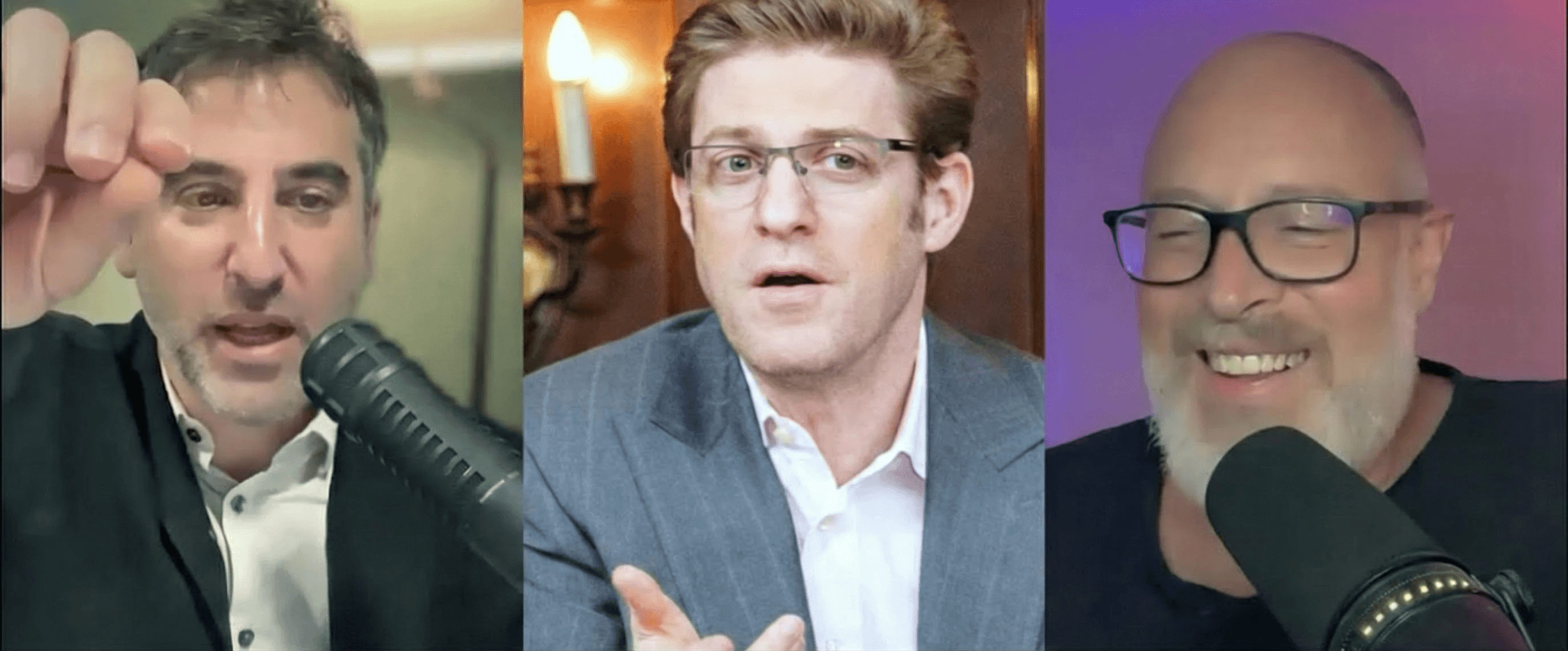
Hosts: Seth and Lio
Guest: Rabbi Mark Wildes
Lio: This is TheJewFunction, and we're very, very happy to have with us today Rabbi Mark Wildes. He's obviously a rabbi, but he's much more than that. He's actually also a writer. He's a connector, if you will. I follow the work that he does, and I listened to a few episodes of his podcast. Actually, the last episode you had was with Shai Davidai, right? About the book that you wrote. And Shai Davidai was on this show, actually, last year.
Mark: The Jewish Experience.
Lio: The Jewish Experience, exactly. Which helps bridge the old traditions with the needs, desires, and questions of young Jews, right? I think they call you "The Millennial Rabbi."
Mark: Yeah, that was actually a very good description. I used to be called "The Millennial Rabbi." I don't know how much longer I can continue to be called that. I told you I became a grandfather, and I'm trying to come up with a name. I could be Zayde, like my father, of blessed memory, was. But I feel like that's just going to make me too old and unrelatable to my students in their 20s and 30s, who are like my kids' age now.
Lio: Amazing. Yeah, when I saw your pictures, I thought you were like 40 or something.
Mark: I appreciate that. They are good Wildes genes.
Lio: Yeah, exactly. Some good genes. Sydney Sweeney has good genes; you have good genes.
Seth: What's going on in New York, first of all? Can we ask you? Is New York good?
Mark: New York is... we're still here. It's amazing. I mean, the time we became mayor...
Seth: Just the election happened, but not the term.
Mark: Yeah. You know, the police still say hello to you in the morning. I'm a little concerned about things. Obviously, I was not happy about the election, but I'm an optimist. I think that there's a greater plan. I'm only a rabbi, not a prophet, so I can't pretend that I know the greater and the bigger plan.
Seth: So we'll get into that. At least somebody has a plan. But here's the main thing—for everyone who wants to know, we're talking about the New York mayoral elections. [Zohran] Mamdani just won, and he wants to divest from anything New York has invested in the State of Israel. He also wants to reduce police and be lighter on crime.
Lio: Globalize the Intifada and the rest of the other things.
Seth: But it turns out that looking at the demographics, about a third of the Jews, if I'm correct, voted for him. And also mostly your demographic—that millennial, the young people who are probably saying to themselves, "Yeah, my rent is too high. Yeah, I don't have faith anymore in the old politicians who are full of corruption. I want life to be better for people." So, the impetus you can't really blame; the execution we can find fault with. But these are your people, right? These are the people that you've been working with, millennials and Jews. Can you tell us who these people are and what's going on inside of them?
Mark: I think you characterized it correctly. You're giving them the proper benefit of the doubt that they're looking to better their situation. I think there was some statistic that by the age of 30, half of Americans were married and had a home in the 1950s or 60s. Now, so much of that has changed. People are coming out with a lot of student debt and they are not making enough money to pay the crazy rent because it's impossible to live. Half of my students don't live in Manhattan anymore. They live in New Jersey and Queens because it's become so unaffordable. So there is that legitimate need.
I think it's the height of naivete to believe that giving free stuff away or just taxing the rich more is going to solve the problem. They're looking for a quick fix. However, the bigger problem amongst this millennial group is that they're not upset enough about the anti-Semitic, anti-Israel statements that Mamdani has made. I don't think they don't care, but I think they make the same chiluk—the same distinction—between anti-Zionism and anti-Semitism as Mamdani, and they bought into that distinction.
They believe that you can be against Israel and against what Israel is doing to the Palestinians—which they perceive as wrong, as evil, and as occupying. How else can you explain so many young people being against Israel's right to defend herself? Because in their minds, Israel is an occupying force. And an occupying force does not have the moral right to defend itself; it should simply give back the territory that people feel the Palestinians were entitled to and the Jews—the colonialists from Europe—just usurped. Unfortunately, they bought into this narrative.
That's the most upsetting thing about the election of Mamdani. Not just that we have an anti-Israel anti-Semite in power in New York City, the most important city in the country, but that too many young people voted for him because they bought into what I consider a false narrative about Israel. Now, I'm doing my part. Anyone who walks into MJE [Manhattan Jewish Experience] will get hit over the head—in a very nice and open way—to discuss why that is a false narrative. We discuss why Jews have been there, and all of the opportunities the Palestinians have been offered by Israel again and again to have peace. There's nothing more that the Jewish people throughout the world, Israel, and the diaspora want than to live side by side in peace with the Palestinians. Very few Jews want them out completely. They just want to live next door to someone that's not hostile to them.
Lio: On that note, obviously many guys who come here support Israel, whether they agree with every policy or disagree. Nobody agrees with everything everybody else does, let alone an entire state and government. What alarmed me is that people are so disconnected from many other aspects. Put Israel aside—let's say Israel is too contentious. But the history of Islam, the aspirations of Muslims—especially extreme Muslims—the foundations on which this religion was created... We're not even talking about the broader picture of how it fits into the bigger play, which we have an explanation for as well. But just if you did some research into that—tribal societies in the Middle East—understand the dynamics. Come out of the library and deal with realities.
Mark: You're pointing out something so important. That's the other aspect I didn't touch on. If you have what I just said, plus you're getting your history from TikTok, and there is this culture of not checking what people say anymore, it's a very dangerous combination. What we try to do at MJE is educate. We try to be as neutral and dispassionate as possible about presenting what we believe is the history. Like what you just said—there are distinctions between more mainstream Islam and jihadist Islam. A lot of young people are learning, but it takes them a while.
Seth: Once you get them in the door, you can talk to them. Maybe just having the experience of sitting around the Shabbat table and singing helps. We do some events a couple of times a year, and for us—we've been doing this for so many years—it's second nature. But a lot of people who come to our events, it's the first time they ever sat around a bonfire and sang songs. You can see they're in shock. Someone puts an arm around their shoulder, you're singing, someone's offering them food, everyone's smiling... It's the experience everybody wants to feel. Once you get them in, they say, "Oh, I didn't know this is what my people do." But how do you get them in the door?
Lio: Before you answer, just take a half step back for us. Not everybody knows what MJE is. Tell us, how did you come about that?
Mark: They're actually both the same question, because "how do you get them in" and "what is MJE" are really one and the same. I started MJE 27 years ago, in August of '98, because of what Seth just brought up. I didn't feel there were enough Jews being brought in. There were just not enough of our brothers and sisters sitting around the Shabbat table or around the campfire at a Saturday night kumzitz. So I started an organization that promoted programming for 20s and 30s: ski retreats, spring retreats, trips to Israel, Shabbat meals.
I would say a Shabbat meal is still probably the most impactful and cost-effective experience. Probably risking my teacher—may he be well—Rabbi Riskin used to say, "For the price of a chicken, you could save a Jew."
Seth: Much more affordable than a ski trip.
Mark: Oh my God, you have no idea. The ski trips are great, and we sell out every year a month in advance. You get that kumzitz moment on Saturday night after spending a beautiful Shabbat and skiing on Friday. It's the best. But yes, it's money and you have to subsidize. That's part of my answer to you: Make stuff cheap, but not so cheap that you're giving it away for nothing.
I love Birthright, and I do Birthright trips all the time, but Birthright and many other people in my field of outreach have succumbed to the whole "let's give it all away" model. Then you have people who come from means and are not being asked to give back. If you don't have any skin in the game, it's not going to last very long. But like anything else, it's a hook.
I started MJE to engage our less affiliated Jewish brothers and sisters. My mother, of blessed memory, and my father are probably my two greatest inspiring agents for this. We had an expanding Shabbat table growing up in my home in Forest Hills, Queens. Both my parents were children of refugees—my mother's side from Germany and my father's side from Poland, Bialystok. They loved this country and the Jewish community, and they helped build it right away. My brother and I were raised to be civic-minded and to believe we can make a difference. We all worked for our local members of Congress and our Senators. We all became lawyers; that was just a rite of passage. I guess that's the Jewish part of us—you have to have the thinking tools to be able to implement whatever change you want to make.
It just took off. It was an experiment for the first couple of years. Now, we have about 20,000 to 25,000 attendees a year coming through our doors for events, classes, retreats, and seminars. It doesn't take very long when somebody starts coming to feel the love of their Jewish brothers and sisters and to learn some of the basics of history.
When this thing started on October 7th, I gave a series of classes just on the history of what's been happening the last 20 years, from the disengagement until today. The level of ignorance is massive, and it's hard to reconcile with the level of education. I teach Wednesday nights—our big night of classes—and I'll have 30 people sitting in my classroom. If I went around, the average level of education in that room is a Master's, a Doctorate, or a law degree. We are such a literate and educated people, yet when it comes to our own history, philosophy, culture, and Torah, it's sad. That's one of the reasons I wrote the book.
Seth: Let's get into that. Here is a main point, and we've discovered that we have to find out: Mark, what's the goal? What's the goal of the whole thing that you're engaged in? Depending on where you plant that flag, everything else to get there changes. Some people, when we ask that question, haven't even thought of it before.
Mark: I think about it every day.
Lio: Maybe before you tell us about the goal, answer the question that we ask everybody who comes on the show: What is a Jew? Who is a Jew? How would you define a Jew to an alien who landed here and saw this tiny group of people that has so much influence and draws so much attention? Who are they?
Mark: You guys are really good. You're teasing out the same things from different angles. The Jew is that unique creature that you can say was chosen, or that chose. I heard this from my teacher, Rabbi Riskin: when God comes to Avraham and says "Lech Lecha," that was only after Avraham had already pursued God. That's my understanding of the chosenness.
Lio: Also, the word in Hebrew, Am HaBechirah, doesn't imply... that word can mean that you have to choose every day that you were chosen, or maybe both.
Mark: Yeah, it's a relationship. If you don't choose Hashem, you don't get chosen. The only reason I think Hashem came to the Jews to reveal His magnum opus on wisdom for the world and chose the Jewish people is because we already had a relationship with Him. That creature, that unique creature that was either chosen or elected to be the messenger for God's word—His light—in this physical world. That's who we are. We are supposed to be sharing some of the divine in an otherwise physical world.
Seth: Okay, so lovely because it's very clear to you and you're able to articulate that. Then what does that look like? What would a world look like where the Jewish people shared God's light with the world?
Mark: I think we've done some of it. The Rambam [Maimonides] himself wrote that Christianity and Islam, to some degree—as problematic as some of their tenets are for the Rambam—nonetheless created a vocabulary and an acceptance of certain basic Jewish concepts.
What that would look like is us reflecting a certain spiritual wisdom to teach and share. But it's not teaching from "we're here, the rest of the world is over here." We're all human. We share the same DNA. We are bringing to the rest of humanity this gift—the gift of the Torah. That includes its various laws, traditions, and wisdom on how to access spirituality in a physical world, and how to use the physical world towards a connection with something greater. Happiness really comes from leading a life of meaning and purpose, and there's nothing more meaningful than living in accordance with the purpose of your creation.
Seth: Who would not want what you just described? I think everybody would want that. Most people in that millennial group, for example—what you just described is so beautiful. Who would not want that?
Mark: I think many people would want it. I don't think we've done a great job marketing it, to be honest. I think Judaism has been marketed as a bunch of rituals and laws. It hasn't really been presented as something that could unlock the greatest depth, brilliance, wisdom, and spiritual connection you could ever want.
It wasn't like God was lonely and needed people to worship Him to make Him feel good about being the King. No, Hashem is the ultimate giver and wanted to share His goodness. That's where the word "good" comes from—it comes from God. This ancient idea in many civilizations is that the greatest goodness can only come from being connected with your source. The Torah was designed for all of humanity, not just for Jews. Now, the Jews have a particular role to play, just as I'm not jealous of my friends who are Kohanim [priests] who minister in the temple. They have a different function. Unfortunately, we've allowed the rest of the world to think that Judaism is just for Jews and just about doing things to please your maker.
Seth: Don't you want to know what it looks like inside the Kodesh HaKadoshim [Holy of Holies]?
Lio: We'll send him a picture later. Just finish the thought—you said we've allowed what?
Mark: We've allowed the rest of the world to think that Judaism is just for Jews and simply about doing things for someone else.
Lio: I think that's a good description. There's another issue: when we started to delve into the sources, you find out that almost everything written in our holy books—the Bible, the Talmud—has an internal meaning. But we're sort of just reading on the surface. Seth and I found that we got a lot of the terminology off. We sort of forgot the real meaning of words. We borrowed ideas like, "God is someone up in the sky granting wishes," or "spirituality is inner peace." We lost touch with the inner meaning. I'm curious, when you talk about spirituality and the Creator, how do you define those concepts to people?
Mark: I think you have to explain as best as you can, and there are certain works that do a better job of it. Rabbi David Aaron does a really good job of explaining basic Kabbalistic terminology. Or Tanya—I taught Rav Shneur Zalman of Liadi's book of Tanya for the last two years. You start picking up on phrases in the prayer book and understanding that this mitzvah brings a certain kind of spiritual energy into the world. We're doing these things because they matter; they impact the world and bring it back to its original purpose.
It's interesting you asked about millennials. They are really attracted to this kind of vocabulary and literature. 30 years ago, outreach was more about the rational stuff. I have a lot of that in my book too, trying to make a rational case for God, because there are still math/science types for whom spiritual talk doesn't resonate. You have to figure out a language that resonates with your audience.
In the first chapter of my book, I talk about finding God from without and finding God from within. Finding God from without is looking at science, nature, and complexity. Or looking at Jewish history. I think the greatest evidence of something beyond us is the fact that the three of us are having this conversation right here. By all intents and purposes, we should not exist. No other minority group has lived amongst a majority culture for so long in so many hostile environments and not been physically annihilated or culturally assimilated.
Seth: I see on X [Twitter] people saying, "You guys have been kicked out of hundreds of countries; don't you realize there's something wrong with these people?" If we imagine that dust has been evolving for 14 billion years in order to reach the connection with the Creator—that bestowing, endless force—that is not straightforward. It's not straightforward to open a business or find a parking spot on the Upper West Side. So to imagine that humanity will get to the point where they become conscious, God-aware creatures is going to be a rough process.
We have this interesting thing where nature reveals the backside, and our responsibility is to flip it around and show the good. Something recently happened in our community where someone was connected to negative press, yet you get more publicity than you could have ever gotten on your own. So, what is your goal now, especially with these young people in New York City?
Mark: My goal ultimately is to inspire Jewish pride.
Seth: And to turn it around. All these anti-Semitic things are happening, and now the Jews are in everyone's mouth. How do we flip it to the good?
Mark: We have to show the positive side. If the only exposure you have to your Judaism is listening to anti-Semitic, anti-Israel attacks, it's not going to inspire Jewish commitment. My goal is to inspire Jewish commitment. Rabbi Jonathan Sacks, of blessed memory—we're coming up on his fifth Yahrtzeit—was all about inspiring Jewish pride. You can't get Jews to take their Judaism seriously if they're not proud of it.
If you're in the news all the time but you're not proud of your Judaism, that's not something you're going to want to perpetuate. I started MJE to get our less affiliated brothers and sisters on track with that. You do that by inspiring them with Jewish knowledge and wisdom.
Lio: I want to push on that a little bit. We get guests who talk about Jewish pride as a stepping stone to something else, something greater. I imagine you've experienced some form of anti-Semitism. Do you have a clear explanation of why there is anti-Semitism? Not just now, but throughout history.
Mark: I have experienced some forms, though nothing like our bubbies and zaydes in Europe. I caution my students about getting too sucked into any "reasons" for anti-Semitism. Once you start paying attention to the reason someone gives for why they hate the Jew, it's just a smokescreen. Rabbi Soloveitchik famously taught that in the history of anti-Semitism, nobody attacked the Jew directly. It was the Temple, the Talmud, now it's Israel. There's always something because anti-Semitism has to be socially acceptable.
Haman convinced Achashverosh to kill the Jews because their laws were different and they kept apart. Hitler said the opposite: they are marrying our daughters, taking over banks, getting too close. So which is it? These are not reasons; these are excuses. I don't believe it's rational. I think it defies rationality. It's a freak of nature embedded in our history. I'm concerned about giving a reason for it because if you fight against that reason, you think you solve it. Theodore Herzl said, "They hate us because we're Jewish, so I'll assimilate." The Dreyfus trial demonstrated that it doesn't matter how much you assimilate; they're still going to hate you. I don't pretend to know theologically. Sorry if that's an unsatisfying answer.
Lio: I'm happy you're in this place because that's where we were as well. When you only focus on the reasons, you see they contradict, so it's irrational. But when you look at the patterns of behavior between Jews before an outbreak of a pogrom or expulsion, you see something changed in how we related to one another. The sages all talk about "Love your friend as yourself" being the great rule. It's the one principle we don't always live by.
Mark: When you say "we don't always live by," you mean in terms of the way we relate to each other, Jew to Jew? I think that's a fair way of portraying what always preceded anti-Semitic incidents. It's the greatest challenge because "two Jews, three opinions." We have to figure out a way of staying as family even as we vehemently disagree.
Seth: We're not going to solve it by battling. Peace doesn't mean I subjugate you or that everyone shaves off their differences. Peace is two opposite things existing together. We need to find a goal—let's call it love or unity—that's bigger than all of our differences. Before each tragedy, the Jews were often at each other's throats. Just look at October 6th.
Mark: You don't have to go so far back. October 6th, the Maccabees—it's all the same. The Maccabees story was against Hellenized Jews, a civil war. You two have hit on what I believe is the one thing we must solve. We're not going to solve anti-Semitism without it. Maybe anti-Semitism is a symptom of our internal problem.
Seth: You were going to tell us how to do that! That's why we invited you.
Mark: I think we have to find something we can all agree on. I thought it was Israel, but we have fringes on the left and right who aren't with us.
Seth: Let's start with the ones who can agree.
Mark: There's nothing more magnificent and life-saving than the creation of the State of Israel in the last 2,000 years. I think most can agree on that. But I don't think it's a good idea to put all our eggs in that one basket. We need Shalom Bayis [peace in the home]. You can't keep arguing at the Thanksgiving table.
I pride myself on raising my kids to value people irrespective of their beliefs and to see the soul within them. But we're not spending enough time with each other. If a very Orthodox Jew doesn't spend time with a secular Jew, or if I don't spend time with a Satmar Jew, I'm only going to know stereotypes. We need forums where we can get Jews that are very different to hang out with each other—not to convince the other who is correct, but just to hang out.
I'll tell you a quick story. I went on a bike run to Tuscany. There was a Satmar Jew named Shmuley—who wore the spandex, so we called him "Satmar in Spandex"—and David from Australia. The first day, they got into a screaming fight about the Israeli army. Very Jewish. But after biking for four days and having Shabbat together, they chose to sit next to each other. Something clicked. Shmuley wasn't convinced about the army, and David wasn't convinced about the Satmar lifestyle, but they found a shared humanity.
We have conferences for everything—Yeshiva University gets together with the RCA and calls it Achtus [unity], but everyone is Modern Orthodox. Real Achtus is getting different groups together. My son was in a COVID hotel in Israel, and he said everyone fell in love with each other because they were stuck in the same place.
Lio: If only there was a way to take Jews from different places and make them be together without it being a concentration camp.
Mark: When Rabbi Soloveitchik went to the 80th birthday farbrengen of the Lubavitcher Rebbe, the Rebbe noted how beautiful it was that the descendant of the Briskers and the descendant of the Baal HaTanya were sitting together. Rabbi Soloveitchik said, "That's not the only time Jews have been brought together. Hitler brought all those Jews together."
Lio: That's exactly what we're trying to prevent here. We want to learn the right lesson from history, not just "never again" and "strong army."
Mark: I applaud you for pushing me on the Achtus issue. We need practical ways of promoting love because we're never going to convince each other of our respective truths.
Seth: We don't have to. There are 12 Shvatim [tribes]. There are 10 Sfirot. We don't need to be the same.
Lio: On the contrary, we need to show humanity that you can have contradictions within you. In your physical body, acid and base live side by side to sustain the human.
Mark: So how would you deal with the pushback against the draft, which is creating such division?
Lio: The rift between secular and religious is historic. Ben-Gurion couldn't foresee the ultra-Orthodox becoming such a force. Everyone is going to have to take steps toward each other. There is an image of two donkeys tied together trying to reach separate piles of hay; they have to come together to eat. We are seeing labor pains of everyone reluctantly taking a step.
Mark: Our enemies have been defeated again and again because of their lack of unity. Look at Milchemet HaShichrur [War of Independence]. We benefited from that. It's like two families planning a wedding who don't know each other—it's the worst situation. It would be better if they were friends first.
Lio: So what we're saying is: be friends. Let's get closer. I don't have to like everything about you, but I have to love you.
Seth: If I love you, I don't want to hurt you. If we increase the love, a lot of the problems just go away.
Mark: I asked why they were marching against the draft now. Someone said they wanted to wait until a ceasefire, but they didn't. I don't know how to inspire that sentiment other than getting to know each other better.
Seth: Let's turn to the Creator and say: We have a desire. We don't know how to unite the Jewish people, but we need You to be with us. We want to be Your emissaries and spread Your light. We are asking You to help us unite the Jewish people.
Mark: Beautiful. We do that before a mitzvah—L'shem Yichud, for the sake of unity. We ask Hashem for help.
Lio: I have a quote for you to read from the Zohar, from Acharei Mot.
Mark: "Behold how good and how pleasant it is for brothers to sit together. These are the friends as they sit together and they're not separated from each other. At first, they seem like people at war, wishing to kill one another. Then they return to being in brotherly love. The Creator says about them, 'Behold how good and how pleasant it is for brothers to also sit together.' The word 'also' comes to include the Shekhinah with them... By your merit there, there will be peace in the world."
Wow, there's so much here. Hashem needs to be part of this. The word "also" includes the Shekhinah. You can't have peace between two people if one person is in turmoil individually. You can't love others if you don't love yourself. Nothing helps a person in pain more than finding someone else going through the same thing.
Lio: You just realize that there were not issues in the first place.
Mark: It's hard to imagine. I'm thinking about the draft, or when we opened MJE in Tel Aviv and had issues with gender-separate seating on Yom Kippur. We need to fly higher together, get above it, meditate, sing, and come back. Most of it will melt away.
Lio: It will have melted away. The Creator just wants us to unite.
Seth: Connected and with Him.
Mark: If we wait to fix all those problems before connecting, it's not going to happen.
Lio: A married couple is a good example. They have a baby; they didn't solve all their problems first. The baby required them to rise to a higher place.
Mark: That's a great metaphor. If you're too careful, you're never going to have the baby.
Lio: We need to be more adventurous. I feel like we have a great partner in this incredible new friend.
Mark: I mean that sincerely. If there is any forum we could create... I have it at MJE to some degree, where people don't feel judged.
Lio: We're on it. First of all, thank you for coming. Number two, buy the book Beyond the Instant—Wait, that's the first book.
Mark: Buy that too. The new one is called The Jewish Experience.
Lio: The Jewish Experience. Good luck with the book. Number three, we'll think of something we can do together. And number four, come back in a few months.
Mark: That would be a great honor. Let's stay in touch.
Lio: This is TheJewFunction. Amazing talk with Rabbi Mark Wildes. Follow him, check the links, and leave a comment. Have a great day, everyone. Bye-bye.