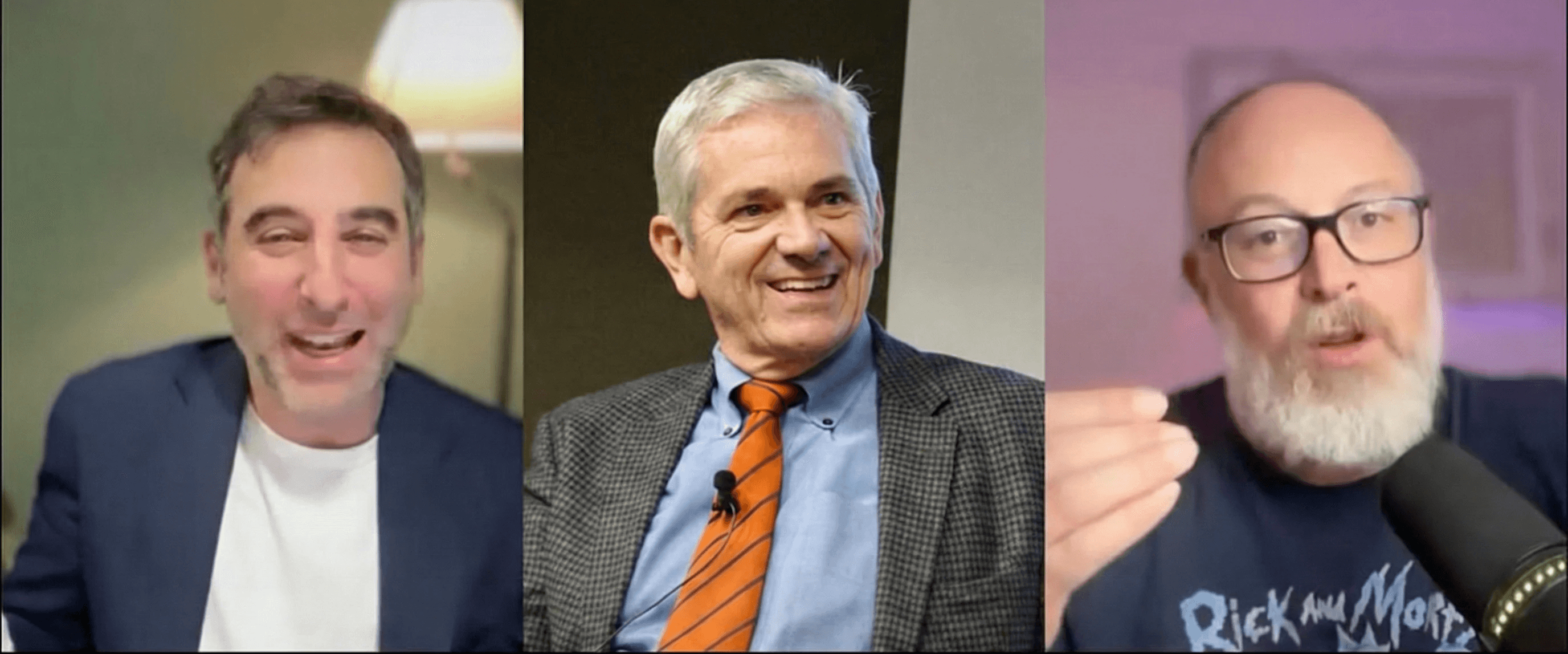
Lio: Hello, everyone. Welcome to TheJewFunction. I'm Lio.
Seth: Hey, everyone. Seth.
Lio: And with us today, a very special guest. I actually heard about Tom from NPR. I used to listen to NPR a lot when I was driving.
Seth: Me too.
Lio: So the name popped into my head. He was the—
Seth: Before podcasts, there was NPR.
Lio: Exactly. He spent four decades reporting on global conflicts and U.S. diplomacy. He's done some award-winning work from Sarajevo to the Pentagon. You actually reported from the Pentagon on 9/11, right? If I'm not mistaken?
Tom: I was in the building. I was in the building and evacuated with 20,000 other people.
Lio: Wow. So he was in the building. I wasn't in the Twin Towers, but I was 10 blocks away.
Seth: In New York?
Lio: Yeah, in New York. I was going to school that day. He wrote books on war, on Cuba. He wrote the book Bacardi on the Bacardi family, which I want to read. It's interesting—about immigration and identity. And now he also writes for Moment Magazine, an online magazine. And we will have, by the way, the founder of Moment Magazine on our show next month. So stay with us. We are very happy to have Tom because among some of his recent writings, he started to write about the rising anti-Semitism on the right. We thought the right was safe. It was only on the left—if you just, you know, it'll be fun. But here you had to come in and ruin it all for us. And now we have to beware of the right as well. So we'll talk about what he found. It's quite a long, lengthy article, but it's a worthwhile read. We'll put the link in the description. Obviously, if you're here for the first time on TheJewFunction, please like, share, subscribe, hit the bell to get notifications when we're up. Leave a comment because it helps spread the conversation. So, Tom, welcome to the function. Thanks for being here.
Tom: Thank you, Lio.
Lio: I think we want to start with—let's just get right into it and ask you a very straightforward question. What exactly is happening in America right now? Specifically, you talk about in your article about the rise of Christian nationalism. I think people who are listening, especially to our show, maybe not everyone understands it. What is Christian nationalism and why is it suddenly in the spotlight? Why is it becoming so powerful?
Tom: Well, I would say the short answer is that there's been a kind of evolution or even a transformation of the Christian right. The Christian right has been a powerful force in American politics for 40 or 50 years. But that force has really changed in recent years. 40 or 50 years ago, the Christian right was—remember the Moral Majority—evangelical Christian support for Republican candidates was very important. But the Christian right in those days was much more focused on specific niche policy issues: abortion, homosexuality, school choice. And theologically, Christian evangelicals were more conservative in the sense that they focused on issues of personal salvation, individual faith. And what has happened in the last few years—
Seth: Like the Pat Robertson, Jerry Falwell kind of guys?
Tom: Those are the guys, right, exactly. And what's happened in the last few years is that the Christian right has really been much more characterized by Christian nationalism. And this has had some pretty profound implications. This is what we can talk about. The Christian right, the evangelical Christians, are much more focused on taking power. They're more explicitly political in that sense. They actually want to take control of governments at all levels—local, state, national. And they want to build exclusively Christian institutions and really impose Christianity on the whole country. They see America as being a Christian nation, and they want to reinforce that, strengthen it, build it. And this actually creates some problems for non-Christians.
The old Christian right with respect to Jews was actually somewhat philo-Semitic. They saw Jews as still having a covenant with God. They saw Jews as having a biblical claim to the state of Israel, to Judea. They honored that. There was a somewhat apocalyptic aspect to this, which is that they believed that Jesus Christ is going to someday return to earth and establish a kingdom in Jerusalem. And that when that moment comes, you either become a Christian or you perish. So there was a kind of dark side to this. But that was considered to be so many millennia in the future that it really wasn't of much concern in the present day to Jews. In fact, there was strong Jewish support for that movement. There was a group called Christians United for Israel that had a lot of Jewish leaders in executive positions.
And now that has really changed. The Christian nationalists that I have been writing about no longer recognize the Jewish people as having any special claim to Israel or to any kind of covenant with God. They call themselves supercessionists, and they believe that Christianity has superseded Judaism as God's chosen faith. And that is obviously an anti-Zionist position. I'm not saying that all anti-Zionists are necessarily—or that anti-Zionism is implicitly anti-Semitic. But that kind of attitude has really opened the door to anti-Semitism. Because once you don't see the Jews as having any special meaning, significance, validity, that really does open the door to anti-Semitism. And the new Christian nationalists, some of them are explicitly anti-Semitic. It's really quite horrifying to read some of their sermons, writings, and so forth. They are not afraid to go straight into anti-Semitic diatribes.
And one other interesting note here is that the Christian nationalists of today don't recognize any such thing as a Judeo-Christian tradition. This is something that conservative Christians have long upheld, that there is a Judeo-Christian tradition. That is explicitly rejected by the Christian nationalists that I've been writing about. So you put all these things together, it has created a climate in which anti-Semitism is unfortunately flourishing in this corner of the Christian right.
Lio: I'm curious, how is it that they reject the whole foundation—the bedrock of Christianity is Jewish? Jesus was a Jew. It's all founded in that. We had a guest on the show who's a reverend in the UK. And she's all about championing the root of Christianity being Judaism, and that's why we're connected and so on and so forth. What drives their hostility, you think?
Tom: Well, some of the more hardcore Christian nationalists are quite explicit about this. And what I'm going to say has a lot of familiarity for anyone that studies anti-Semitism. They believe that the Jewish people fundamentally, most Jewish people in Israel, rejected Christ. And that God then punished Israel as a result of the Jews' rejection of Christ. To the point that some of them argue that the destruction of the temple in the year 70 AD or Common Era was actually God's judgment on the Jewish people, that he called for the destruction of the temple. So they point to that date, actually, as the date when Christianity's relationship with Judaism was fundamentally and permanently broken.
Seth: Hold on, Lio, just one sec. I think that if there's 3,000 religions, everybody's going down the road of why certain people believe something that they believe. It's a fun exercise, but we have Tom for a short amount of time. And I think maybe we drive to the heart of something else a little more specific.
Lio: Go for it. I was just curious about one clarification, and that is that if—because it has to do with our topic—if Jews were finished, if the Jews had to disappear from the religious arena, even maybe called spiritual arena, they could have disappeared there and then. Exile, assimilation, end of story. It happened a million times. Why not with the Jews? What's keeping the Jews around? We have a theory, but I'm curious to know if you ever thought about that as well.
Tom: Well, actually, what I know about this is, I have to say, in part from listening to TheJewFunction, because that's an issue that you have explored in some detail. I mean, I remember from one of your episodes, you talked about how with all the religions of the world that have existed over the last 4,000 years, how is it that Judaism is the only one that has survived up until now? That's something that I can't really go into. I can tell you that Christian nationalists think that there's something fraudulent about that. There are actually Christian nationalists that believe that Jews aren't really Jews, that they are Europeans who have, for practical reasons or strategic reasons, allied themselves with the Jewish world. But I don't want to get into that.
Seth: If we were to—anybody who started a business or raised a family or worked on a project or had to shovel the driveway understands that there's challenges. I think if you take a primitive, savage human being from 10,000 years ago and try to raise him to be a godly person, to think that we aren't going to have many failures, challenges, problems is not really being honest with oneself. I'm not talking about you. I'm saying anyone who wants to criticize this venture here that we're calling Judaism—there's this concept like, well, God told you to do this and you didn't listen to him and therefore you're being punished. It's as if—I remember I said to my dad when I was a kid, I wanted a horse. He's like, okay, here—he gave me a brush. He goes, brush the dog every day for a year, I'll get you a horse. Then he walked out of the room. And I thought like 20 years later, I thought back to that. I was like, I had no—I was seven years old. I didn't know how to set up a schedule and discipline. And what if I didn't feel like it one day? To grow as a human being towards this divine concept of what we imagine that we should be, it's a long, arduous process. It's not like God told you to do that—how could you have done anything wrong? So this is, I think, a fascinating conversation. I'd love to sit down and have some coffee together and open all of this up. But Lio, maybe we can try and get into the hostility against Jews.
Lio: Well, hostility toward Jews is nothing new. What's interesting is that you write about these guys, Yoram Hazony and Josh Hammer, right? Two Jews who are joining forces with the Christian nationalists. Even as you just sat here and described all those terrible things they think about Jews and the anti-Semitic tropes they use in their language. Why do Jews keep forging alliances with people who eventually turn against them? This is, again, historically proven. What's the story here?
Tom: That's actually a key question that I set out to explore in this piece. And there are a couple of aspects of it. One, you alluded to, which is that a lot of conservative Jews see conservative Christians as co-belligerents in the war against radical Islam, against wokeism, against globalism. These are common enemies. And there was a feeling among some of them—and Josh Hammer is like the best example of this—that it made sense to have this kind of alliance with Christian nationalists on behalf of this greater struggle against their common enemies.
There was also an ideological connection. This would be more Yoram Hazony. Yoram Hazony is well known as an advocate for nationalist organization. He believes that states should be oriented around their own national tradition. And he looks obviously to Israel. He's an Israeli nationalist. He lives now in Israel. He was born in Israel. He was educated in the States, but he's a Jewish nationalist. And he is of the opinion that nationalism makes sense. It coheres a state. It gives it identity. He wrote a book in defense of nationalism in which he lays that out. And if nationalism is good for Jews in Israel, why can't it be good also for Christians in the United States? This idea that a country needs a central religious cultural tradition to keep it together—that was his ideological explanation.
But what happened is that in the last few years, as they began to see what was happening with Christian nationalism, for both Yoram Hazony and Josh Hammer, there was some kind of awakening. I was at a conference—I write about it—just in September where Yoram Hazony gets up—there was a conference promoting nationalism as an ideology. And he gets up in front of this crowd and he says, "I have to tell you that I didn't think that Christian nationalism was going to be a threat to the Jewish people up until about a year ago. And now I realize that I was mistaken. I did not see this developing." People like Tucker Carlson, Nick Fuentes, Candace Owens, some of whom really identified with Christianity, and now they have come very close, in some cases even explicitly, to positions of anti-Semitism.
Josh Hammer said basically the same thing, that he now recognizes that this is a much bigger threat than he thought it was. And he told me that he has not talked to a single Jewish person recently who does not see Christian nationalism as a serious threat. He said it's a five-alarm fire for us.
Lio: So I guess the logical follow-up question is: do you think America is slowly becoming inhospitable to Jews? Some people claim—we hear on the show and other occasions—that America has treated Jews so well and this is the second home of the Jews away from home and so on and so forth. And yet at the same time we also had some guests who said safety for Jews is a relative thing, it's a temporal thing. Today it's here, tomorrow it's elsewhere. You've got to have a suitcase ready and just move, roll with the punches to the next country that can host you. Do you feel that?
Tom: I think America has become less hospitable to Jews. I think it's become less hospitable to Muslims, to atheists. There has been a growing ethno-nationalist force, particularly on the right, that rejects some very fundamental American principles. And the best example of this is J.D. Vance. Vice President J.D. Vance gave a speech a couple of months ago in which he came right out and rejected the idea of a creedal approach to nationalism. The old idea was that Americanism is not a cultural thing. It's an ideological thing. You become an American by accepting and committing to certain principles outlined in the Declaration of Independence, the Constitution, our documents. That America is defined by its creed, not by any particular cultural or religious tradition. And to the extent that this has characterized the approach to American politics and American culture for the last century at least, in that context, I think Jewish people felt comfortable in this country. Because as long as Americanism, the idea of Americanness, was not defined in cultural or religious terms, but in ideological terms, this was a place where Jews could flourish—and have flourished.
And I think that what is worrisome is that you now are seeing a real rejection of that whole idea and a return to a much more ethno-nationalist view of the American identity. And that is not a view that is going to be hospitable to the Jewish people.
Seth: Tom, Ray Dalio, who manages one of the largest hedge funds in the world, has studied—in the introduction he says, "I needed to figure out a way to make money for my clients, whether the economy was going up or going down." And so he had his research team look at empires over the last thousand years or several hundred years. The book is The Changing World Order: Why Nations Succeed and Fail. If you haven't seen it—there are many parameters as you can imagine, but if you get very high level and not looking at all the dots on the graph, but looking at the curve that they make, you see the exact same patterns that happened in the Netherlands, that happened in England. He kind of leaves China out—it's a little bit different, it's a little bit different pulse in a sense, although it does fall into it as well. But what we see in America is following—you can—and this is what Lio and I have seen through Jewish history. Every couple centuries you can change the costumes and you can change the scenery, but it's the same kind of cycle. Maybe we could say it's a spiral, not just a cycle. And Ray does a great job in that book of even giving all kinds of graphs and you see where things are.
Here's my question to you. You're pointing out a lot of data points and they're very legitimate and they're very real. Without a George W. Bush, we probably wouldn't have had a Barack Obama. Without a Barack Obama, we probably wouldn't have had a Donald Trump. So what's interesting to us is not just that the pendulum swung all the way to the left and there was a lot of open immigration and there was all the COVID stuff and all this, and so now it's going to swing all the way to the right. We have all the data points to show that. But is there something specifically unique or something that we need to be aware of? At a certain point, it leads to a war—a serious like civil war. So that's when we have to be very cautious. But the fact that it's swinging, nobody should be surprised. If we look at it, it's like physics, right? You hit the ball against the wall, it bounces. So just the fact that it's swinging back to the right after what we just—after the last eight years or so—it's not a surprise. But, Lio, help me formulate the question that we're trying to get to here, if you can.
Tom: Are you saying, should we be worried about this or not? Or should we just see it as a natural development?
Seth: Well, I think it's a natural development. We say for sure it's a natural development. But what is the—things get to a breaking point. Maybe that's what we're trying to say. How do we exit out of this abusive cycle? Is there some way—can we, with all of the history, with all of the intelligence, with all of the experience—is there some way to be grownups as human beings? And just, okay—because you know what's going to happen after we swing all the way to the right? We're going to swing all the way to the left. Look at the French Revolution. Look at any of these things in history, right?
Lio: Maybe the question is, what's at the root of it in your mind? Maybe it's not just politics, as you said. Clearly, it harkens to human nature. And you've been around the block for a while. You've seen people in all kinds of situations—stressful situations, war situations, tragedy, drama, all those things. Maybe talk to us about the human nature perspective here. Let's leave the politics aside for a second, because behind the politics, there are people. What motivates the people? What are people after? And maybe that will help us learn what we need to do.
Tom: Well, one of the most powerful instincts, I think, for humans is the need to attach themselves to a tribe, to have a tribal identity. And I think that one of the things that we have seen over the years—and this is not just in America, this is not just in the last couple hundred years, as you've pointed out—is when people feel their tribal identity is under attack or threatened, it makes them lash out. When they feel the tribal identity is secure, then they are more relaxed. And in terms of the changes that you've seen, I would map onto that what is happening culturally at those moments. I think one of the things that you have seen is that sense of tribal identity at some point seems to—people see it as being imperiled. And that's when you get these right-wing reactions.
Now, my last book looked at the impact on America of the 1965 Immigration Act, which opened America's doors for the first time in history to immigrants of color from all different nationalities. Up until 1965, our entire immigration policy favored white people from northern and western Europe. The passage of that act really transformed America. Now, right now, like nine out of ten new immigrants to the United States are coming from non-European countries. It's almost the exact reverse of what it was 60 years ago. And as a result, the character, the color of American people has fundamentally changed. And there has been a reaction among more culturally conservative white people that this is scary. I think within the next 10 years, America is going to become a majority non-white nation.
And my book that was published in 2015 was at the peak of the previous flow that you were talking about. And it actually had a very optimistic tone. It said that America has demonstrated a capacity to absorb new people and to become a much more diverse nation. And it has demonstrated its resilience. And our whole idea of America as an idea rather than a nation has really been reinforced.
Well, shortly after that book came out in 2016, Donald Trump came along. And these demagogic politicians can appeal to people's fears in a very effective way. I saw this in Bosnia, in the former Yugoslavia, a country that for 50 years after the Second World War was actually coming together and had fractured along ethnic lines in the 40s, was coming back together. And then you got a few demagogic politicians—Slobodan Milošević, Franjo Tuđman, Alija Izetbegović—who, as their own power base was weakened, began to appeal to people's fears. And that's what happened.
So it really depends on what is happening culturally within the country, but also on the ability of leaders to rise above that and keep people on an even keel as opposed to appealing to their worst instincts.
Lio: Well, I would challenge that a little bit just by saying—okay, maybe just part of it. Everything you said about how politicians use people's fears, that's certain. The question I have is different. Is there really a set of ideas that everybody who comes to America actually subscribes to? As you said, that creed—are people really into that? Because you made some comparison to Israel initially, especially when we talk about nationalism and all that. In Israel as a Jewish state, you could argue that there is some sort of a unifying idea. In fact, we claim that Jews are people of ideology and nothing else. We're not unified ethnologically, biologically. There's nothing. Even religiously, it's hard to say because there are so many different streams. There is an ideal that unites Jews. Not everybody knows about it or knows of it in full. And that's what we're trying to bring to people. But it's certainly something you can talk about. And our sages have been talking about it. And so if you come here, the country will kind of force you to adapt to it or will spit you out in a way.
But in America, what is the idea? I immigrated to America for the 22 years I was living in America. I came because I picked a few ideas. I didn't care about the freedom to this. And I couldn't vote. I was living—I paid my taxes. I was like a legal citizen, but I had fewer rights compared to some of the illegal immigrants that came in the last decade. But I was doing everything. I paid my taxes and everything. But I just chose a few things that I liked. I liked the anonymity, the relative freedom I had to do whatever the hell I wanted and pursue whatever I wanted. Nobody interrupted me to think whatever I wanted to think. I kind of wanted to get away from everything. And so I'm not sure that there is such an ideal in America that everybody subscribes to. And maybe that fear that people feel is justified. And maybe we lack such a unifying ideal.
Tom: Well, I don't think it's necessarily that everybody sees the same idea. One of the things I found in writing my last book, in which I profiled non-European immigrants coming to America, is that they all had a different idea of what America stood for.
For some, this was economic opportunity. It was a place where, by individual initiative, you could get ahead. You weren't judged on the basis of your class or your education. This was really a land of economic opportunity.
There were some who came here—they actually found it to be a tolerant place. I profiled a pretty devout Muslim who felt that America was even more—definitely more than other European countries—supportive of his religious freedom. That he could become a devout Muslim without feeling like he was alienated from the rest of the society.
There was a Korean man I profiled who was really motivated politically by the founding of America and the ideals in America's founding documents.
There was a woman from El Salvador for whom safety was the issue. America was a place that was safe. It wasn't a really violent place.
But what united them all is that they were very quick to answer, "What does America mean to you?" It meant something. There was an idea. They had different ideas. But in each case, America stood for something—different ideas of what it stood for. It stood for something. The fact that people were able to come to this country for so many different reasons, but for reasons—it didn't come arbitrarily. Everything about this place attracted them, and that reinforced their patriotism in a sense. It reinforced their American idea, American identity, even though it came from different places.
Seth: You take a country like China, for example. You have a few billion people. Or even if anyone here is a—any of our listeners are part of a homeowner association, or part of anything where you have to—or I see these, for my work, I see the co-op boards and all these buildings in Manhattan. You would think it's like Biden versus Trump in every single building in Manhattan, the way people are at each other's throats, just in a building with 100 people, just to get everybody to agree to the same thing. I'm not talking politically Biden versus Trump. I'm just saying like the new board wants to overthrow what the old board did. And these ones think it should be like this. About everything.
Tom: Well, Seth, I got a question for you.
Seth: Sure.
Tom: Is that phenomenon that you're describing—has this changed in the 20 years you've been doing this?
Seth: Very much so. So many managers that I deal with say it is such a difficult process to get the board to come to some kind of decision. It was always a difficult job. But yes, the last few years, it's become increasingly more hostile in all people's homes. And these are the buildings where people live.
So my point is that in China, for example, during COVID, in a totalitarian—I don't know if we can say that—government, what did they do? They said everybody's going to stay home and they just welded them inside their house and that's it. That's how we're dealing with it. A very top-down approach.
In the United States, we want to have this individual freedom. But the question is, if for the last 60 years, I lived in a town and we celebrated—we did the Pledge of Allegiance in the morning at school. And during Christmas time, we exchanged Christmas cards or something. And everybody said Merry Christmas in school. And now 40% of the town doesn't celebrate Christmas. And they don't want any mention of Christmas in school. So whether it's right or it's wrong, you can imagine I've been here. I went to the school. My father went to the school. My grandfather actually built the school. And now there's people coming in. So we can see that there's going to be a clash.
Now, the main thing that we see with the Jews is that you have Yemenite Jews. You have Russian Jews. You have Ethiopian Jews. There is no common thing except the ideal. We say with the Jews, the ideal has to be love the other as yourself. It means it doesn't matter what your background is. If we love each other, we're going to be able to figure something out together. If we don't—if I love you and you love me, I don't really need nuclear bombs because you're not going to try and kill me. But if we don't have love, we need a lot of other systems around because I don't know what's going to happen next.
So the ideal—we feel that the ideal that the Jew needs to bring to the story is the ideal of love the other as yourself. That's the contribution besides the Nobel Prizes and cherry tomatoes and anything else that the Jews invented. The ideal of love the other as yourself has to be the contribution. But when it comes to America, if we don't have this love of the other, then we're just going to swing back and forth until a breaking point, which would be a world war or civil war. And then everyone will reconstitute again and then back and forth until another breaking point. And then again.
Tom: Right.
Seth: So you point out very clearly that this process is happening again. And if it's not mitigated somehow or corrected somehow, we could get to the point of a civil war in the United States. Also, Germany was not a Nazi country. Germany was a very progressive, very advanced country that got stirred into a fervor. Nazism is not a German phenomenon at all. This is a phenomenon that can happen. Like what are those—what are those psychological experiments—
Lio: Yeah, there's the famous Stanford Prison Experiment if you remember.
Seth: By—you know this one, Tom, where they took some of the students and—
Tom: Yeah.
Lio: Some are prisoners, some are guards.
Seth: Some are guards.
Lio: And always a famous experiment in human nature. And when he divided the class into prisoners and guards and they said you have to play it out, and people took their roles very, very seriously and realistically. But again, that's not the only—
Tom: Was there something in that experiment where people were divided according to the color of their eyes or something like that?
Lio: No, not in this one. But there were other experiments that also tried to favor other things. There's no question that the fear of the other also plays into that. There's no question. I think I'll sum up because of everything said.
Ultimately, we're not sitting here thinking that, oh, just love everyone and that will solve the problems. We think it's a very difficult task, but it's a task that humans have to pursue. The question is, first of all, are we willing to acknowledge that there's a problem with human nature that prevents us from settling on a solution and rather we have to oscillate between these wars and conflicts all the time? You seize power, then I seize power. Then you seize power and break everything I built. Then I seize power and break everything you built. How long are we going to be—you call them demagogues. But even demagogues wouldn't be able to do it if it didn't appeal to a feeling people have. So maybe we should start addressing the feelings people have, the natural sensations, what is in it, what prevents me from relating to the other as a family member. What do I need to do to work—what kind of work needs to be done? What kind of environment do we need to create to foster such an attitude? It is possible. And what we say and what we show is that Jews lived this way before. We were a microcosm for this experiment. Thousands of years ago, this was the case, and now Jews were actually exiled precisely in order to rekindle that memory and restart this experiment on a global level. What do you think of that?
Tom: I want to say one thing, and I think you probably know this, that I'm not Jewish. I was raised in a conservative Christian environment, and I'm most familiar with that kind of Christian worldview.
I think that there is something unique about Judaism among world religions, which is that in clear distinction to certainly Christianity and also to Islam and even to some extent the Eastern religions, there's just no impulse to proselytize in Judaism. There's no pressure. Jews don't put any pressure on people to convert to Judaism. This is not the case with Christianity. You see, Christians are always trying to convert people. Muslims obviously are.
J.D. Vance made a very strange comment the other day. His wife is not Christian. His wife is South Asian. She's Hindu. And he actually said that he hopes that someday his wife, Usha, will see the light and become a Christian. This idea that somehow you can't accept people as being your equal if they're from a different religious background—that is just not something that I have ever seen among Jews. And so I don't know whether that explains why Jews have been able to assimilate and get along all these many years. But it's certainly something to me that I find appealing that I don't see in other religious traditions. I don't know if that makes any sense to you.
Lio: No, it makes a lot of sense. In fact, Jews are known to push people away. Even those who try to become Jews, they try to dissuade them—"Why? You don't need that headache." And yet people do feel that because we trace that to a deeper desire in a person's heart. In other words, because Jews were founded on an ideal, as I said—it wasn't a nation that already grew out of a natural bond between people and then expanded. It was an ideal, and then this ideal was reinforced by this group of people. Eventually, it left this signature, let's say, in people's hearts, let's call it, for lack of a better placement. And their desire is to also seek that. And we meet a lot of people who are not Jews who also feel that inclination towards that. And if you feel that inclination and you want to choose it as something that you want to pursue, you're welcome. But any other way is not relevant, precisely because in its root, it's not a religion in the sense that people consider a set of rituals that bind you to a certain belief in some afterworld. There's no such thing. It's actually a very practical thing. And disclaimer, most Jews don't even know about that. That's about as much as we found out already. But this is the story that we're trying to bring to the surface.
And I'm curious because based on what you said, if you're not Jewish, why even bother? There are so many other stories to write. Why do you write about anti-Semitism? What's drawing you? I mean, it's not just the fact that we're not proselytizing. What is it?
Tom: No, there's a practical reason for that. My last seven years at NPR, I was the religion reporter, and I really focused on issues of religious identity and relations between religion and politics and so forth. And Moment magazine actually reached out—when I retired from NPR, a former host of All Things Considered at NPR by the name of Robert Siegel had gotten to work as a book reviewer at Moment. And he was very familiar with my work. And he said, "I think that Moment would be a good place for you because the stories that you write are of great concern to Jewish people. And you bring an experience in writing about these issues that we could take advantage of."
And so it was not that I wanted to write for a Jewish audience. It was that this particular Jewish publication really welcomed me and recruited me and asked me to write for them. I mean, Moment Magazine is not parochial. It's very broad-minded. It's not highly ideological. It's obviously a magazine for a Jewish audience. But the interest is in a wide variety of issues. And there was a feeling that my expertise and my knowledge and my journalism is something that would be of great interest to Jewish readers. And that's why they brought me in. And I have found it to be a really welcoming place. I could be writing for the Christian Century, for example. The Christian Century is a very progressive magazine, mostly associated with the Christian left. I could be writing for The Atlantic. I could be writing for The New Yorker. But this is the publication that is very specifically interested in what I have to offer.
Lio: Is that because your Jewish wife told you to do it? That's okay. You don't have to answer that question.
I'm trying to think—again, I'm appealing to your sense of perspective that you have and everything that you've seen in the world and human nature. And we're trying to consult with you because, A, we started to talk about whether America is becoming inhospitable to Jews. And while Seth and I are trying to get to the root of the problem and to the systemic solution behind it—which is we think Jews need to do something—until that moment the Jews wake up and actually reassume that position in the system of nature, because the system needs them. It's not because they're unique. Someone has to do it. So it's that group. It could be any other group. Right now it's this group.
The question is, how can we help the world, Jews in it, buy more time? Because once you deteriorate into a civil war, into a world war, it's very hard to stop it. It's one of those events that have to play out. You know how it is. Once big events—it's like a big ship. You can't just stop it. I mean, look at Russia and Ukraine. Even—you think after all of our experience with world wars and pointless wars and wars with millions of casualties, someone would at least be able to—and you can see that. No, it's like there's enough people that are willing to or are unable to even see beyond that. And so when will it end? I don't know.
Trump thinks he can bring peace to every place in the world. So far, his peace is made of plastic. Sorry, Mr. Trump, for saying it. I haven't seen any of it. He can get a plastic Nobel Peace Prize because Cambodia and Thailand are at war. Israel is definitely at war with everyone. I don't know what kind of peace is he talking about. Everybody still wants to kill all the Jews. Russia and Ukraine are at war. He's about to get into war with Venezuela. So I don't know.
So the question is, again, more practical. What do you think we need to do? How can we maybe buy ourselves more time, more peaceful time in which we can talk to people, have a conversation?
Tom: If you talk about anti-Semitism, for example, there was this predominant feeling—and I think you, Lio, mentioned this at the beginning—that this was a problem on the left. And then there becomes a realization that it's also a problem on the right.
I think if we stop looking at these issues in such polarized terms—is anti-Semitism a right-wing problem or a left-wing problem? Is the recognition of human rights something for the right to promote or something for the left to promote? If we get out of this black and white approach to the world and start looking at these issues and problems on their own basis without prejudging according to our own personal preferences, to me that's the way to start.
That's why I have become—I'm 77 years old and I have covered the wars in Central America. I covered the horrible conflict in the former Yugoslavia. I was at the Pentagon. I've seen a lot. And what it has led me to is a complete rejection of extremes. I think that it's that kind of extremist mentality, whether it's on the right or the left, the polarizing mentality, the idea that you classify people as being either your friends or your enemies. If we can get away from that—I have become kind of a radical centrist in my old age.
Seth: What is that common denominator, Tom?
Tom: Common denominator is just not judging people on some external idea, but just accepting people where they are and honoring certain principles that may or may not be associated with the right or the left, but getting out of that kind of dualistic view of your fellow humans.
Lio: Can you lay out a few of those principles? Maybe let's get a list going.
Tom: Well, one of them was what we're talking about here today. Anti-Semitism. Stop seeing anti-Semitism as a problem of the left or a problem of the right. Anti-Semitism is a problem because it's just a bad thing.
And again, I mentioned human rights. Why can't we agree that we as a people need to honor humans for what they are? I think that actually Judaism and Christianity and Islam, a lot of the world's great traditions, have these ideas embedded in them, and they get thrown out of context or something. But I mean, you can help me with this. It just comes down to treating your fellow—and you mentioned this before—treating your fellow human being with a certain sense of dignity and not judging them according to some arbitrary external thing.
Seth: Okay, this is great. Now if we were to say—when we were tribal, lived communally, there was not a lot of individuality at the time because we were closer to kind of like animals. We did things seasonally. When the sun set, we slept. When the sun came up, we woke up. In this season, we harvest. In this season, we look for berries. In this season, we procreate, etc. There was not a lot of individuality. And there were not so many decisions to make because a lot of our life was instinctual.
Today, we're very, very individualistic. And especially with social media, we're very much shattering into—each person lives really in their own—and podcasts and everything else. When I was in college, it was Rush Limbaugh and it was NPR. That's what there was. Now, there's people out there with 5 million followers. None of us have ever heard of them, ever. Right. So now that we go into this very individualized world, and not only is it individualized, people feel strongly. And not only that, we still have our instincts. There are people who are very much on a team. You have a pitcher and a catcher. You have a striker and you have a goalie. You have people who have different—you have an accountant and you have a salesperson. It's different mentalities. It's different kind of creatures. It's like a jungle. You have a peacock and you have a leopard. You have an elephant and you have a tiger. So we can't flatten everyone out, like we were back in the past, more just communal. So we want to find this center in a world where nature is pushing us to all be individuals.
What I'm wondering is—we talked, I mentioned a few times about the swing to the left and swing to the right, the swing to the left and swing to the right. It was Hitler or Goebbels who said that if you tell a lie enough times people believe it. That's not a flaw. That's actually—what do they say in technology? It's not a bug. It's a feature. It's an actual feature in the system. If you tell people enough times to buy this hamburger, they're going to buy that hamburger. If you stop advertising and start advertising to buy this hamburger, they're going to buy that hamburger. There's an actual feature in the system that if you tell people enough times, they're going to do it.
Why don't we just keep flooding the world with the message of love or the message that we're all in this together or we're all part of one human family? Let all the details kind of sort themselves out. But we can't solve the fact that everyone's an individual. Nature won't let us. We used to be communal. We're getting further and further into our own worlds with the Internet and everything else. We're not going to stop.
Lio: And just a small addition: not in a naive way, like in the 70s—"Oh, love, drugs, and rock." No. Looking at the beast that's inside each person and saying, there is such a thing. How do we work with it? How do we work around it? How do we corral it? How do we ride the donkey rather than letting this donkey ride us? It's time for an in-depth exploration.
Tom: There's a couple of things that I learned when I was covering religion at NPR. One of them had to do with attitude towards homosexuality. What I found is that if you happen to know personally a gay person, someone in your social circle or family circle, you were likely to be a lot more supportive of them. And the resistance, the hostility, was really centered among those people who didn't have contact with gay people, didn't know any of them personally. And the more exposure that you had to someone of a different sexual orientation, the more accepting you would become of them. And this is almost, I think, a rule.
And the same thing happened with our growing ethnic diversity. Where you saw the most hostility to people of other backgrounds was precisely in those communities where they had less exposure to people of other backgrounds. In those communities where there was a lot of diversity, you actually found more tolerance. This is borne out by data. So I don't think that necessarily people are instinctively as judgmental as we might think. If you give people the opportunity, if people have the actual experience of dealing with other people, people of the other, they actually—I mean, I sort of remain kind of optimistic in that sense.
Seth: What are the conditions? Under which conditions? Because like we said, your father and your grandfather grew up in this town and now 40 percent of people come in with it—you can't just put them together and expect the experiment is going to work. You have to create conditions for the experiment to work, especially if the people coming came from a totally different mindset and a totally different culture and totally different—
Lio: Yeah, at least some sort of a buffer. Again, speaking from my experience, when I came to America, nobody said, "Listen, we're going to keep tabs on your value system, on how you treat other people." None of that. Just here are the laws. Don't break them. And goodbye. Pay your dues here and there. Get the proper stamp in your passport every year or so. Put a bag of money on the table and you get the papers and that's it.
But if you tell people, listen, you're coming—I just saw, as we were talking, they published this message from Trump, saying we're going to ban all the people from all the bad countries, he calls them. Somalia, this and that. Like, we need to bring more Norwegians in here, something like that, he said to that effect. But basically, he wants to ban all Muslim countries from exporting those people from there.
And again, to some extent I understand them completely. You take people with radically different value systems from you, totally different religion—not simply different religion, a religion that—really, you talk about supersessionism on the Christian side, talk about that on the Islamic side. You're looking at Armageddon really quickly here because they are convinced that Judaism and Christianity are redundant. So you're bringing me to your country and you expect everybody to get along, let alone in this town allegory that Seth made.
So I think we need to start investing more time in this education. Educate the other. "Hey, look, you're coming into this community who's never seen you before. This is how you should conduct yourself." And then, "Today, hey, you're going to see some people you've never seen before." A little talk, start to invest a little bit. This is what we'd love to see, some investment into the study of human nature.
Tom: You know, this has actually happened under George W. Bush. They really revised the whole naturalization process. And I'm a big supporter of this. I think that the requirements for citizenship should be quite stringent. I really think that if you want to become a citizen of the United States, you have to commit yourself to certain principles. We do not believe in female genital mutilation. We do not believe in inferior treatment of women. Some of these ideas that come in other cultures—if you want to come here, you have to reject those values that may have found a place in your previous culture, but will not be allowed in this country.
I think that we can be quite explicit about the requirements to become an American—not ethnic requirements, not religious requirements, but basic freedom requirements. I would have no problem with some strengthening of our citizenship criteria in that regard.
Lio: I think so too. By the way, we have the same issues here in Israel, even though this is a tiny country. Same thing with people, foreign workers who come here and then get assimilated into the social fabric. But without at least committing to some framework of values, something to say, "Look, this is how we do things here."
And it's funny because every other place you go to—you go to a stupid golf club, they tell you, "These are the rules. You want to be a member here. These are the rules. If not, get out of here." So why can a golf club be so stringent, but in a country where your whole livelihood depends on it, it doesn't apply? We invest so much in so many other things instead of that one issue. Understand how people operate. Start working with it, not against it. Because eventually, people will snap back out of anything. You can't just expect people to just—you have to go through the process. It's called education. Otherwise, there will always be a snapback.
What was that? Wasn't there like a snapback during the Kamala Harris thing? There was some snapback.
Tom: Oh, the sanctions on Iran, right? That was the snapback on that.
Lio: It took me a second. Yeah, I don't know why I associated it with Kamala. But that's it. We're very good at doing it in some places, but terrible in other places.
Seth: And I think that behind all this, what we saw is that through the human experiment, this small group went through many pressure cookers through all these different empires—went to the Persians, went to the Greeks—well, let's go back, went through the Egyptians, went to the Babylonians, went through the Greeks, went to the Romans. And this small group of Jews had to assimilate and build bonds and connections through all of these groups. And somehow, from maybe from above, who knows, they were able to maintain. And we all know that when we go through difficult times in our life, those are the formative moments for us.
So the premise now is that this small group needs to bring the message of unity. And maybe somehow to your audience, you can somehow figure out how to—not telling you what to do, but maybe asking a special request to somehow in a sneaky, creative, crafty way, weave that message of unity as much as possible in there. Because what happens inside that little Jewish community somehow ends up manifesting throughout the world. The Jews are like this little microcosm. And you probably might be surprised that you probably have some Jewish something in you very deep in there somewhere.
Lio: We call it the point in the heart.
Seth: We call it the point in the heart. Yeah. Don't blush, but—this connection gene, because it's not a people, it's not a genetic people, although there is—the gene companies can kind of trace and say you have some Jewish gene. But when Abraham got these people together at the beginning of this group, it wasn't based on genes. It was based on an ideal. And this ideal is: we, as different as we all are, we have to unite. That is where this whole thing is going. And it's either going there two ways—one, through a lot of pressure and a lot of trouble, or by being big boys and looking at our history, reading the books, looking at the big goal in front of us of where we need to go and learning together, helping each other together, finding those points of commonality and becoming like one human family.
Lio: Yeah. I couldn't agree more. So, Tom, before we let you go—
Seth: Tell the world, would you?
Lio: Before we let you go, we ask our guests to read a quote from one of the Jewish sources. I have a quote for you from Baal HaSulam, if you'll do us the honor to read it. Baal HaSulam was a great Kabbalist of the 20th century—the greatest Kabbalist of the 20th century—Yehuda Ashlag. And he wrote extensively about the condition of the world as well. He didn't just write about the interpretations of the Torah. He really tried to use modern language, external language, to communicate ideas to all the people. Not just Jews, but I would say even more external circles of the Jewish people as well, to bring them close—science and everything.
And so I'd love for you to read. I think this is quite apropos. It's a little dense, but I think you can pull it off.
Before I let you read it, I just want to say to everyone that if you haven't signed up to TheJewFunction, please do it. This is the only place that talks about the root of anti-Semitism and the solution to it according to the laws of nature. And we do it by bringing some really interesting people. And we talk to them about things that you won't hear them talk about anywhere else. So like, share and comment on this conversation because it really helps.
Tom: [Reading from Baal HaSulam]:
"A branch that extends from the internality is the people of Israel, which has been chosen as an operator of the general purpose and correction. It contains the preparation required for growing and developing until it moves the nations of the worlds to achieve the common goal. The branch that extends from the externality is the nations of the world. They have not been imparted the qualities that make them worthy of receiving the development of the purpose one at a time. Rather, they are fit to receive the correction at once and to the fullest, according to their higher root."
Lio: It's very dense, like I said. He actually places the nations of the world in a very unique position and the responsibility of the Jewish people toward them. But like I said, Seth and I didn't come up with these ideas. We are speaking from the shoulders of—
Seth: Sure are.
Lio: Right. So, what can I say? Thank you.
Seth: Huge gift you gave us today, Tom. Thank you for spending time with us today.
Lio: Yeah.
Tom: It's been fascinating. I love to talk about these issues, particularly with thoughtful people.
Lio: Nice. You're also one of the best readers we've had. So we may bring you to read more quotes for us.
Tom: I'm probably the best. I was a broadcaster.
Lio: It's true. It's true. Tom Gjelten, thank you so much for being here. This is TheJewFunction. And we'll see everybody next week. You can see Tom's article in the link below. And also I'll throw in links for his books. I'm interested in that Bacardi book. So I'm going to see that.
Tom: We can talk about Cuba. I have strong feelings about Cuba. We can talk about Cuba sometime too.
Lio: I know, we could. So we hope to hear more from Tom and stay close—you're in our circle now forever.
Tom: Wonderful, thank you so much.
Lio: Take care and all the best, everyone. Bye bye.
[End of transcript]